Showing posts with label conquest. Show all posts

Thursday, September 3, 2020

Social Structure in early Roman Egypt

 The social structure in Aegyptus under the Romans was based on a system of social hierarchy that revolved around ethnicity and place of residence. Other than Roman citizens, a Greek citizen of one of the Greek cities had the highest status, and a rural Egyptian would be in the lowest class. Gaining citizenship and moving up in the ranks was very difficult and there were not many available options for ascendancy. One of the routes that many followed to ascend to a higher social class, as in other provinces of the Empire, was through enlistment in the army. Although only Roman citizens could serve in the legions, many Greeks found their way in. The native Egyptians could join the auxiliary forces and attain citizenship upon discharge. 

The Augustan period in Egypt saw the creation of urban communities with “Hellenic” landowning elites. These landowning elites were put in a position of privilege and power and had more self-administration than the Egyptian population. The Romans looked to these elites to provide municipal officers and well-educated administrators.  Essentially, this amounted to the Greeks being treated as an ally in Egypt while the native Egyptians were treated as a conquered race.


Image: Late 2nd century CE painted lime plaster mummy mask of a male with inset glass eyes at the Royal Ontaraio Museum in Toronto, Ontario, Canada courtesy of the museum.

If you enjoyed this post, never miss out on future posts by following me by email!


Monday, September 28, 2009

Possible Victims of Trojan War unearthed in Turkey


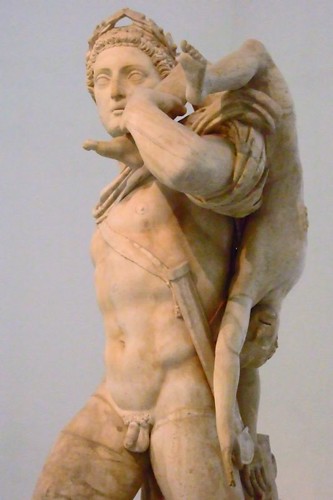
A team from the University of Tubingen, led by Ernst Pernicka, have uncovered a pair of skeletons in the ancient city of Troy near ceramic fragments dated to the period of the Trojan War. It is discoveries like this that remind us how important literature like Homer's Iliad is to understanding our ancient past. It will really blow me away if they find a skeleton of an infant with its head crushed. We could then be looking at the only corporeal remnant of the famous Hector, trainer of horses!

[Image - Warrior with captured child, Roman copy of 3rd century BCE Greek original. Photographed at the Museo Archaeologico di Napoli, Naples, Italy by Mary Harrsch.]

This discovery, though, also raises the question about disposal of "enemy" dead after a catastrophic sack. Both the Greeks and the Trojans at the time practiced cremation. If skeletons are found that could have been retrieved for burial, it makes a person wonder if the Greeks not only violated religious taboos by slaughtering people who had fled to the temples for sanctuary, but did not grant the defeated and enslaved survivors the courtesy of properly burying their dead either. Perhaps the violent deaths later visited upon the Mycenaean victors were just desserts after all.

"Pernicka said pottery found near the bodies, which had their lower parts missing, was confirmed to be from 1,200 BC, but added the couple could have been buried 400 years later in a burial site in what archaeologists call Troy VI or Troy VII, different layers of ruins at Troy. professor of archaeometry who is leading excavations on the site in northwestern Turkey, said the bodies were found near a defense line within the city built in the late Bronze age.

The discovery could add to evidence that Troy's lower area was bigger in the late Bronze Age than previously thought, changing scholars' perceptions about the city of the "Iliad."

"If the remains are confirmed to be from 1,200 B.C. it would coincide with the Trojan war period. These people were buried near a mote. We are conducting radiocarbon testing, but the finding is electrifying," Pernicka told Reuters in a telephone interview.

Pernicka said pottery found near the bodies, which had their lower parts missing, was confirmed to be from 1,200 BC, but added the couple could have been buried 400 years later in a burial site in what archaeologists call Troy VI or Troy VII, different layers of ruins at Troy.

If you enjoyed this post, never miss out on future posts by following me by email!