"One shall tame a might foe, the other strike to save Rome's fame, neither will achieve their aim. Look aloft if you dare, though what you fear cannot fly, both will face it before you die." - Jack Ludlow, The Pillars of Rome
This prophesy by the Alban Sybil, accompanied by a crude drawing of an eagle in flight that bursts into flame of its own accord, set the stage for Jack Ludlow's first novel set in ancient Rome.
"The Pillars of Rome" is the first book in a trilogy by Jack Ludlow set in the late 2nd century BCE. Ludlow is an experienced writer and has published a number of books set in other time periods but this is his first with a Roman theme. Ludlow does an excellent job of developing vibrant characters and deftly recreates Republican Rome with its strict social hierarchy, scheming and corrupt senators and provincial governors, politically motivated marriages, military reliance on landowners (this is before Marius approved career soldiers without land ownership requirements) and strict military "disciplina" in the conduct of its troops who, in turn, extended little mercy to the conquered.
However, Ludlow chooses to populate his book with purely fictional characters, making it more of a challenge for me to identify the time period and discuss the differences between events described in the novel compared to actual historical events like I usually do in most of my reviews.
Ludlow did give me some clues, though, as to the historical personages used as models for his main characters thus pinpointing the period of Roman history as well.
Ludlow's two main protagonists, Aulus Cornelius Macedonicus and Lucius Falerius Nerva, are lifelong companions and the prologue opens with a scene of the two as boys creeping into a dark cavern to clandestinely meet with the Sybil to gain insight into their respective futures. It is soon apparent that Aulus is far more pious and god-fearing than Lucius who is willing to risk eternal damnation to learn if he will realize his dreams of fame and fortune. Aulus' piety will eventually become revered by Roman society and serve him well in his ascension to the peak of military success. Likewise, Lucius' ambition will be the driving force in his future where risk-taking becomes second nature in his struggle to become politically the first man in Rome.
From his cognomen, Macedonicus, we know that Aulus apparently was instrumental in the Roman conquest of Macedon. There were a number of Macedonian Wars but as we read the novel, we learn that he defeated King Perseus, son of King Philip V of Macedon, who ascended the throne in 179 BCE giving us a historical period of the early to mid 2nd century BCE.
Perseus was defeated by the legions led by Lucius Aemilius Paullus at the Battle of Pydna in 168 BCE at the climax of the Third Macedonian War. Thereafter, he became known as Lucius Aemilius Paullus Macedonicus. So, we can assume Aulus is a surrogate for Paullus and examine the life of Paullus to gain historical insight into this personage and the events surrounding this period of history.
In Plutarch's Lives, Paullus is held up as an examplery nobleman with "traditional Roman firmness and courage in adversity" ( an introduction by Philip A. Stadter and Robin Vaterfield to Roman Lives: A Selection of Eight Lives by Plutarch). He carefully prepared for each engagement unlike his nemesis Perseus who is characterized as miserly, cowardly and unfaithful to his mercenaries who he failed to pay.
 |
| Perseus surrenders to Paullus. Painting by Jean-François Pierre Peyron from 1802. Museum of Fine Arts, Budapest. (Photo credit: Wikipedia) |
"What occasion can there possibly be for men to take heart, when victory over others is precisely the time when we are most compelled to be afraid of fortune, and when a happy man can be plunged into the depths of depression by the realization that fate follows a cyclical course and attaches itself to different people at different times?"
This reminds me of the fatalism expressed by Scipio Aemilianus, son of Paullus, upon witnessing the destruction of Carthage in 146 BCE. Polybius reports:
"Scipio, when he looked upon the city as it was utterly perishing and in the last throes of its complete destruction, is said to have shed tears and wept openly for his enemies. After being wrapped in thought for long, and realizing that all cities, nations, and authorities must, like men, meet their doom; that this happened to Ilium, once a prosperous city, to the empires of Assyria, Media, and Persia, the greatest of their time, and to Macedonia itself, the brilliance of which was so recent, either deliberately or the verses escaping him, he said:
A day will come when sacred Troy shall perish,
And Priam and his people shall be slain.
And when Polybius speaking with freedom to him, for he was his teacher, asked him what he meant by the words, they say that without any attempt at concealment he named his own country, for which he feared when he reflected on the fate of all things human."
The son obviously learned this sad truth from his father.
 |
| Detail of The Triumph of Aemilius Paulus (Photo credit: Wikipedia) |
Aulus' [Paullus'] triumph is mentioned several times in the novel and was obviously the crowning achievement of his career. Fortunately, a wonderful description of the three day spectacle comes down to us from Plutarch in his biography of Paullus:
"The first day - and it was only just enough - was given over to the spectacle of all the statuettes, paintings, and statues taken during the war, which were transported on 250 wagons. On the next day the most beautiful and valuable of the Macedonian arms and armour were carried through the streets on large numbers of carts. The bronze and iron parts of the weapons had been polished until they shone, and all the objects had been artfully and aesthetically positioned, so as to look as much as possible as though they had fallen into random heaps of their own accord: there were helmets lying next to shields, breastplates on top of greaves, Cretan targes and Thracian wicker shields and quivers all jumbled up with horses' bridles; the piles bristled with unsheathed swords, and pikes had been planted among them. The arms and armour were somewhat loosely arranged, so that as they were carried along they struck against one another and gave out a harsh and fearsome sound, and even though they had belonged to the losers in the war their appearance was not without its terrors. After the wagons with the arms and armour came three thousand men carrying coined silver money in 750 boxes; each box held three talents' worth of money and was carried by four men. Then came more men carrying silver mixing-bowls, drinking-horns, drinking bowls, and cups, each shown off to its best advantage and each remarkable for its size and for the depth of the chased work on it."
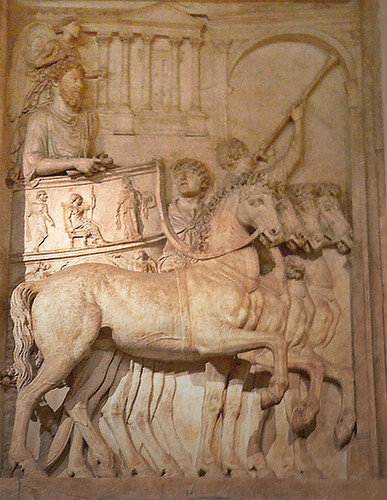 |
Marcus Aurelius driving a quadriga in a
triumphal procession. Photographed at the
Capitoline Museum by Mary Harrsch.
|
"Early in the morning of the third day trumpeters made their way through the streets, but the music they played was unusual for a procession or an exhibition; it was the kind with which the Romans used to rouse themselves in battle. Behind the trumpeters 120 stall-fed oxen, with their horns gilded, and arrayed with headbands and chaplets were being led to sacrifice by young men dressed in ceremonial aprons with purple borders, and boys went with them, carrying silver and gold libation cups. Next came the men carrying the gold coinage, which had been divided up, like the silver money, into vessels with a capacity of three talents, and there were seventy-seven such vessels altogether. They were followed by men carrying the sacred bowl, which had been made, on Aemilius' instructions, out of ten talents of gold and studded with gems. Next came men displaying the Antigonid, Seleucid, and Thericlean goblets, and all the golden tableware Perseus used. They were followed by Perseus' chariot, which carried his arms and armour with his diadem lying on top of them. Not far behind the chariot Perseus' children were led along as slaves, accompanied by a throng of weeping nurses, teachers, and tutors, who stretched out their hands in supplication to the spectators and taught the children to beg and plead. There were two boys and one girl, too young to comprehend the magnitude of the disaster - and this made people feel so much more sad for them, considering the fact that one day this incomprehension would end, that Perseus walked by almost unnoticed by the Romans, who were just staring at the children in pity. Many people started crying, and in all of them the spectacle aroused a mixture of pleasure and pain, until the children had passed by."
"Behind the children and their retinue came Perseus. He wore a grey cloak and Macedonian boots, and looked as though he was utterly astounded and bewildered by the magnitude of the disaster that had happened to him. He too was accompanied by a crowd of associates and friends; their faces were heavy with grief, but because they were constantly glancing at Perseus and weeping they gave the spectators to understand that they were mourning his fate and did not care in the slightest for their own. Perseus had written to Aemilius, asking not to be paraded through the streets and included in the triumph, but Aemilius, apparently in mockery of Perseus' cowardice and fear of death, remarked: 'The situation is no different now from what it was before: he could grant his own request, if he wanted.' He [Aemilius] meant that he [Perseus] could always choose death instead of dishonour, but the coward could not bring himself to do that. Instead, unmanned by hope, he became a part of his own spoils."
"After Perseus and his retinue, four hundred golden garlands were carried along, which had been brought and presented to Aemilius by representatives from the various cities in recognition of his valour. Then came the man himself, mounted on a magnificiently decorated chariot. He would have made a remarkable sight even without all these trappings of power; he wore a cloak dyed with purple and shot through with gold, and held in his right hand a spray of laurel. Every single soldier likewise carried laurel. The army marched behind their commander's chariot in their units and divisions, with the men singing partly traditional songs with an element of humour in them , and partly hymns of victory and praise for Aemilius' achievements."
In the novel, Aulus is said to have ritually strangled Perseus at the conclusion of the triumph but historically this did not occur. Paullus actually arranged for Perseus to be moved from the "carcer" (prison) to a place that was clean "where he could life more like a human being." But Perseus died anyway. Plutarch says some writers say he starved himself to death while others report he angered his guards who, in retaliation, decided to not allow him to sleep, "until, eventually, worn out by this treatment he died."- Plutarch, Aemilius Paullus, Roman Lives: A Selection of Eight Lives, edited by Philip A. Stadter and Robin Vaterfield.
As for his children that were so pitied by the Roman spectators, two of the children also died. But Perseus' son Alexander survived and became an expert engraver and an accomplished secretary.
I sometimes wonder if ritual strangulation was as common as we are led to believe when I read about kings and rulers, like Perseus, that escaped the executioner's rope. Maybe this ritual only occurred occasionally much like fights to the death between gladiators in the arena.
Returning to the novel, I think Ludlow did a superb job of capturing this essence of nobility in his characterization of Aulus Cornelius.
Ludlow's novel makes a giant leap in time from the boyhood of the prologue to the mature years of his two main characters that comprise most of the novel. When we pick up the tale in Chapter 1, Lucius has, indeed, become a powerful senator and leader of the Optimates while Aulus, the consummate warrior, has just returned from Spain where he has been battling the Celt-Iberians who have been stirred up by an outcast Gallic Druid by the name of Brennos. The rebel activity must have been a prelude to the Celtiberian War.
"The Celtiberians, famous for their martial ability, fought a long and bitter war against Rome known as the Celtiberian war (Bellum Celtibericum, 153-133 BCE) and were involved in other conflicts with Rome throughout the 2nd century BC." -John T. Koch, Celtic Culture: A Historical Encyclopedia
Aulus, like Paullus, had fought the Celt-Iberians in Spain earlier in his military career before his victories in Macedonia.
"Rome's most competent commanders were busy with the war against Antiochus the Great when another war broke out in the west, in Spain, where there had been serious disturbances. Aemilius was dispatched there with the rank of praetor, but he had six extra lictors over and above the usual six praetorian lictors, with the reulst that his office was equivalent in dignity to that of a consul. He won two pitched battles against the local tribesmen, who lost about thirty thousand men, and apparently it was plain to see that his success was due to his tactical skill, since he made victory easy for his troops by ensuring that they fought on favourable ground, on the far side of a certain river. He also subdued 250 towns, which were happy to open their gates to him." Plutarch, Aemilius Paullus, Roman Lives: A Selection of Eight Lives, edited by Philip A. Stadter and Robin Vaterfield.
Although Plutarch never mentions Paullus' return to Spain, this is certainly a plausible plot development considering the ongoing conflicts referred to by Koch.
Aulus finds Lucius, who has built his career around his ability to manipulate people with clever words rather than military prowess, mired in a dispute with a tribune of the plebs pushing land reform. This can be no other than Tiberius Gracchus and Ludlow has kept the praenomen Tiberius but given his character a different gens name, Lavonius. Tiberius Gracchus was elected tribune of the people in 133 BCE. Historically, the problem is Paullus was already dead, having died in 160 BCE. So Ludlow has compressed the historical timeframe at this point. The only other reference I could find to earlier land reform efforts was a bill introduced during the consulship of Laelius in 140 BCE that was supported by Scipio Aemilianus but rejected by the senate (Paullus' younger son was adopted by the son of Scipio Africanus because Paullus, having four sons, could not afford to fund that many sons in their efforts to climb the Coursus Honorum).
Ludlow also portrays Lucius as the senator most violently opposed to the Gracchus figure which would make Lucius equivalent to Scipio Nasica Serapio. Lucius, like Nasica, unable to sway Tiberius Lavonius [Gracchus] from his determination to alleviate the inequality between the priviledged wealthy and thousands of Rome's destitute, hires thugs armed with clubs to seek out the tribune and club him to death - the actual fate that befell Tiberius Gracchus.
For those of you unfamiliar with Gracchus' land reform bill, here is a very good summary:
"There already existed a law at Rome - the so-called Licinian law - which limited the number of acres to be possessed by any one citizen to five hundred. But this Licinian law had been a dead letter for many years, and there were many rich citizens in Rome who counted the number of their acres by the thousand or even ten thousand. It was this violation of the Licinian law, and the open injustice done to the poor by this violation, which Teiberius Gracchus wanted to correct. He therefore introduced a new agrarian law which aimed to revive the Licinian law, but at the same time greatly modified and attenuated its provision. The change in the law which Tiberius Gracchus proposed was in one respect an act of injustice, because it put a premium on the violation of the law as it had existed, instead of punishing that biolation by imposing an adequate fine. Under the new law a citizen might hold 500 acres of the public lands in his own name, and in addition, 250 acres for each son still under the paternal roof and authority. Moreover, the new law provided that, whenever a citizen should be compelled to give up land which he held in excess of the share which the law allowed him, he should be reimbursed for this loss, at the appraised value, from the public treasury. Tiberius Gracchus also favored the immediate distribution of the conviscated lands among the poor as their absolute property, and proposed that, whenever a Roman colony was founded on conquered territory, a similar distribution of the newly acquired land should be made." - Francis Johnson, Famous Assassinations of History From Philip of Macedon to Alexander of Servia
There is no mention of any violence surrounding the earlier debate over land reform in 140 BCE. So, I feel I have teased out the historical figure represented by Lucius with a caveat. In Ludlow's novel, Lucius and Aulus have been friends since boyhood. However, if Lucius is really a surrogate for Scipio Nasica Serapio who orchestrated the death of Tiberius Gracchus, Ludlow must have decided to consolidate historical personages with Scipio Nasica Corculum (his father) since it is that Nasica that was more of a contemporary with Aemilius Paullus. It is also that Nasica that served under Paullus in the Third Macedonian War, according to Plutarch in his description of the key battle of Pydna.
Lucius is also portrayed as having no real military gifts except logistics (supply) but both Nasica Corculum and Nasica Serapio served as military commanders with Corculum leading a night action that was instrumental in the victory at Pydna. Serapio, however, is thought to be the praetor who suffered a great Roman defeat at the hands of the Pannonians in 141 BCE. So Ludlow must have decided to soften this disparity with a middle path.
Now, let us return to Ludlow's narrative.
Aulus, suspects Lucius of having a part in the death of Tiberius Lavonius [Gracchus]and withdraws his political support, leaving Lucius angry and resentful. Historically we know Paullus was considered a member of the aristocracy but he was recognized as being of such noble stature that he was considered "above" the day-to-day political mudslinging of the period. We also know that his younger son did openly support the first efforts at land reform under Laelius.
Lucius is also put out about a social snub inadvertently committed by Aulus when he failed to appear when summoned to attend the birth of Lucius' first son because Aulus was dealing with a secret birth within his own household - the subject of a subplot in the novel that will further manifest itself in successive books.
This subplot involving Paullus' second wife is, of course, totally fictitious because of the timeline if nothing else. However, we know nothing about Paullus' second wife from the ancient sources so it isn't really historically misleading. The ancient sources record the name of Paullus' first wife and state that Paullus actually divorced her - some say without adequate cause - even though Aulus is portrayed as a widower in the novel. Ludlow portrays the lady Claudia as barely 16 when she is offered to Aulus, even though he is quite mature, a common practice for the period.
(Spoiler alert) The baby is the result of Paullus' wife being captured by the Celt-Iberians and Aulus and his faithful Greek body servant Cholon take the child far away and expose it where they think no one would possibly find it. Of course, someone does just like in the ancient Greek epics. It's at this point that land ownership requirements for serving in the legions plays an important part in succeeding events.
One of the minor characters, a well meaning but unsuccessful former legionary who has gambled away the plot of land he received upon discharge from the army, is seduced into rejoining the legions as a surrogate for a neighbor who has been far more successful with his own plot. The neighbor agrees to take care of the man's wife and adopted son (the child exposed by Aulus) while the hapless man is on campaign in the neighbor's stead. In the meantime, the neighbor further fattens his pockets by avoiding taxes on his properties because he has had his surrogate enlist under the prosperous neighbor's name, making him exempt from taxation.
I never really thought about this much before since most of my study has focused on the post-Marius reform period where just about anyone could join the legions, but I'm sure these types of deceptions probably occurred during the second century BCE when military service was restricted to landowners. The wealthy have always had carefully orchestrated loopholes to avoid mandatory military service in my lifetime so it would be logical to assume this practice has come down to us from antiquity.
But back to Aulus and Lucius!
To get Aulus out of his way politically, Lucius arranges for Aulus to head an investigation of the corrupt activities of the new governor of Illyricum since Aulus had initially pacified the area earlier in his career.
This background information about Aulus (Paullus) is also based on history.
"After being elected consul, Aemilius led an army against the Ligurians, whose territory ran alongside the Alps. The Ligurians were a warlike and courageous people who were having their military skills honed by the Romans, whose neighbours they were...Aemilius' advance was met by a force of forty thousand, five times the number of his eight thousand men, but he engaged them in battle, forced them back, and pinned them inside their strongholds...The Ligurians trusted Aemilius and surrendered both their ships and their settlements to him. He restored their settlements to them unharmed..." - Plutarch, Aemilius Paullus, Roman Lives: A Selection of Eight Lives, edited by Philip A. Stadter and Robin Vaterfield.
But after his conquest of Macedon, we have no evidence Paullus returned to Illyricum so this coupled with the timeline issue points to the rest of story as purely fictional.
In Illyricum, Aulus finds that the people who he had left pacified were on the verge of open revolt because the greedy governor was gouging them with taxes while at the same time delaying payment to his own legions so he could loan out money in the pay chests and reap the interest for himself. The men of the legions have lost their discipline and are no longer in fighting trim. So Aulus has his work cut out for him and takes command offending the corrupt governor Vegetius. Meanwhile the rebels of Epirus rise up against the Roman administration there. Aulus marches a relief force towards the gathering rebel army near a narrow defile named Thralaxas where he faces the dire fate forecast those many years ago in the Sybil's cavern.
I'm sure Paullus would have welcomed such a heroic end but in fact, he died of natural causes. Apparently not long after being named censor (although Plutarch points out he had time to complete all of the most important things) he fell critically ill. His doctors advised him to rest in the country by the sea so he sailed to Velia. But the Romans missed him.
"...in the theaters they often gave voice to what seemed to be prayers and appeals to see him. And so, when a sacrifice was to take place which required his presence, and his health seemed up to it, he returned to Rome. He performed the sacrifice along with his fellow priests, surrounded by a crowd of visibly happy Romans, and then the next day made another sacrifice, in private, asking the gods to keep him in good health. When the sacrifice had been performed in the prescribed manner, he returned home and lay down, but suddenly, before he had time to notice and comprehend the change, he became delirious and deranged, and two days later he died." - Plutarch, Aemilius Paullus, Roman Lives: A Selection of Eight Lives, edited by Philip A. Stadter and Robin Vaterfield.
I found Ludlow's novel to be culturally immersive and with enough complexity to be intellectually satisfying. His battle sequences were exhilarating and his characters empathetic. I have already begun book two in the trilogy "The Sword of Revenge" and look forward to Aulus' son Titus exacting retribution for his father's betrayal.
|
|
 
|
 
|
 
|
 
|




 "The Legion" is the second book by