Sunday, May 27, 2012

Poison Honey and the Importance of the Classics


My husband brought home a beehive this week so he could learn to become a beekeeper (his latest hobby).  We have multitudes of rhododendrons blooming in the front yard right now and, remembering my Xenophon, when we went to Glory Bee Foods to get some beekeeping supplies, I asked the salesperson if we were supposed to keep the bees shut up during the rhododendron bloom?  She seemed totally clueless so I reminded her of the fate of Xenophon's men who became severely sickened from eating honey produced by bees feasting on rhododendron pollen. She said she had never heard anything about it.  I told her she should brush up on her ancient history.

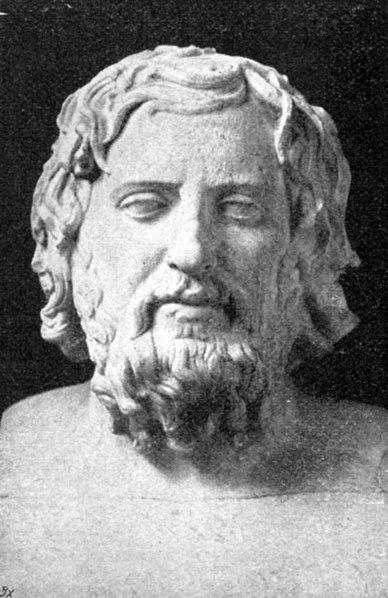
Xenophon, author of "Anabasis" that
relates the famous March of the Ten 
Thousand.  Image courtesy of 
Wikimedia Commons.
"The effect upon the soldiers who tasted the combs was, that they all went for the nonce quite off their heads, and suffered from vomiting and diarrhoea, with a total inability to stand steady on their legs. A small dose produced a condition not unlike violent drunkenness, a large one an attack very like a fit of madness, and some dropped down, apparently at death's door. So they lay, hundreds of them, as if there had been a great defeat, a prey to the cruellest despondency. But the next day, none had died; and almost at the same hour of the day at which they had eaten they recovered their senses, and on the third or fourth day got on their legs again like convalescents after a severe course of medical treatment." - Anabasis by Xenophon, Book IV Chapter VIII

I also pointed out that if she needed a more recent reference she should check out the campaigns of Pompey the Great as well since, he, too, failed to learn from history and suffered from the effects of rhododendron honey when he and his troops were campaigning in Turkey in the 1st century BCE.

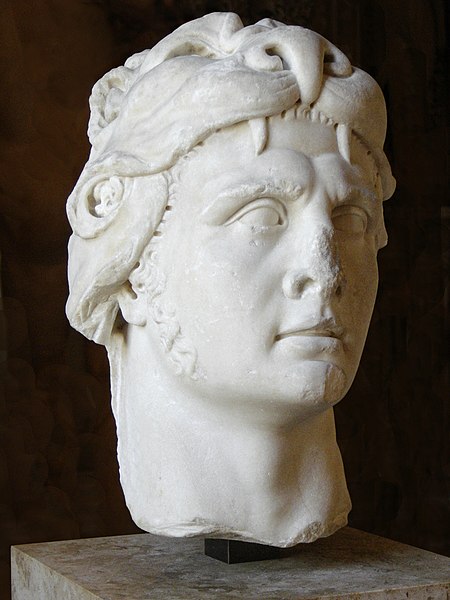
"As king of Pontus and a scholar of toxicology, Mithridates was well aware of the deadly properties of the rhododendron honey of his kingdom.  He would have kept some in his royal laboratory of pharmaka and, as noted earlier, he may have included it in his mithridatium...Mithridates would also have known of Xenophon's misadventure with the poisonous honey..."
Mithridates VI of Pontus, The Poison King
Image courtesy of Wikimedia Commons

"In about 65 BCE, Pompey's army was approaching Colchis.  Mithridates' allies there, the Heptakometes, were described by Strabo as 'utterly savage' mountain barbarians, dwelling in tree forts and living on 'the flesh of wild animals and nuts.'  The tribe was feared for attacking wayfarers - suddenly leaping down on them like leopards from their tree houses.  The Heptakometes may have received specific orders from Mithridates on how to ambush the Roman army.  What we do know for a fact is that they gathered up great numbers of wild honeycombs dripping with toxic honey and placed them all along Pompey's route.  The Roman soldiers stopped to enjoy the sweets and immediately lost their senses.  Reeling and babbling, the men collapsed with vomiting and diarrhea and lay on the ground unable to move.  The Heptakometes easily wiped out about one thousand of Pompey's men." - Greek Fire, Poison Arrows, and Scorpion Bombs: Biological and Chemical Warfare in the Ancient World by Adrienne Mayor

I saw an article last week listing the ten most worthless disciplines to pursue in higher education and among them was archaeology and anthropology.  It looks to me like this is a prime example of information from the past that has direct modern implications and could be one of many examples that could refute such nonsense!


Enhanced by Zemanta
If you enjoyed this post, never miss out on future posts by following me by email!


Wednesday, May 2, 2012

Review: The Legion by Simon Scarrow


"The Legion" is the second book by Simon Scarrow I have read although it is the tenth in Scarrow's "Under the Eagle" series.  I admit I have not read its immediate predecessor "Gladiator" but I had no problem picking up the story line with the background information provided.

The other Scarrow book I read was Centurion and in it, Cato and Macro were both Centurions.  From reading other reviews, I gather that in previous novels, Macro has been the experienced teacher and Cato the young up-and-coming protégé.  In this book the relationship has changed significantly and Cato now holds the superior rank of prefect.

The two heroes are in pursuit of a nasty former gladiator named Ajax who led a slave revolt on Crete following an earthquake and tsunami.

Historically, there have been only three major Roman slave revolts documented by ancient historians - two on the island of Sicily and the famous revolt led on the Italian mainland by a Thracian slave turned gladiator named Spartacus.  Scarrow may have used these revolts to  inform his fictional narrative of a similar revolt on Crete.  Appian mentions a conflict on Crete at about the same time as the Spartacan revolt (a century before the reign of Claudius which is the time frame Scarrow uses for his "Under the Eagle" series) but I could not find anything definitive pointing to a slave uprising on Crete at the time or in a later period.

Scarrow may have pulled his villain from the first Sicilian revolt, though, that occurred on the island of Sicily from 136 - 132 BCE.  It was led by a Syrian slave named Eunus, whose reputation included an aptitude for magic and foretelling the future.  Diodorus Siculus tells us:

"...he not only gave oracles by means of dreams, but even made a pretence of having waking visions of the gods and of hearing the future from their own lips.

Of his many improvisations some by chance turned out true, and since those which failed to do so were left unchallenged, while those that were fulfilled attracted attention, his reputation advanced apace. Finally, through some device, while in a state of divine possession, he would produce fire and flame from his mouth, and thus rave oracularly about things to come.

For he would place fire, and fuel to maintain it, in a nut -- or something similar -- that was pierced on both sides; then, placing it in his mouth and blowing on it, he kindled now sparks, and now a flame. Prior to the revolt he used to say that the Syrian goddess appeared to him, saying that he should be king, and he repeated this, not only to others, but even to his own master." - Diodorus Siculus, Library, Books 34/35. 2. 1-48  

Apparently, Eunus, also called Antiochus, was not taken seriously at first and was used as entertainment at dinner parties.  But his ruthlessness was soon revealed when he was asked to lead 400 slaves against the city of Enna where his men "found their way into the houses shedding much blood, sparing not even suckling babes."

As Eunus' victories over the Romans grew more numerous, thousands of slaves flocked to his banner, much like Spartacus.  Eunus was eventually crowned king by the rebels and among those appointed to his royal council was an Achaean (Greek) who was known for his intelligence and military acumen.  Perhaps it was this Achaen that provided the model for Scarrow's rebel leader, Ajax.

Roman War Galleys were frequent subjects of Pompeii frescoes 1st century CE.
Photographed at the Museo Archaeologico in Naples, Italy by Mary Harrsch.


However, in Scarrow's novel, Ajax and his men, instead of meeting their end on the island as Eunus and Achaeus' men did, have hijacked a Roman ship and are sailing around the Mediterranean wreaking havoc, slaughtering most of the people they encounter and leaving only lone survivors here and there that have been so badly tortured they usually expire shortly after telling their rescuers that they were slaughtered by a Roman named Macro.  Of course this infuriates Macro and raises the stakes as it becomes apparent Ajax is heading for Egypt.

Arriving in Alexandria, Cato and Macro are hauled off to prison and must convince the governor of Ajax's ruse before the governor crucifies Macro.  Fortunately for Macro, one tortured survivor, an Egyptian priest, convinces the governor that Macro was not the man who butchered his fellow priests.  So the governor releases Cato and Macro and they set off in pursuit of Ajax once again with the recovered priest as guide.
But Ajax continues to elude them, slipping through one trap after the next, until the governor interrupts their chase and orders the pair to the Egyptian frontier to help fend off an invading Nubian army.  When Macro and Cato arrive, the governor's commander is acting strangely and our two heroes discover Ajax has joined the Nubians.  Now they must find a way to defeat the Nubians to end Ajax's reign of terror.

Scarrow has crafted a well-paced plot but like "Centurion", I found the characterizations of Cato and Macro quite thin.  I thought carefully about what was missing in the narrative that made the protagonists seem so flat and I realized Scarrow never gives us any insight into their thoughts.  He relates their actions but it's like viewing their activities through binoculars without any insight to what they are thinking.

I thought back on Harry Sidebottom's novels and his protagonist, the Anglo-Saxon born Roman officer, Ballista.  We hear Ballista praying to his "All Father, Death Bringer".  We experience the horror of one of his nightmarish visions of the Emperor Maximinus Thrax who always promises to see Ballista again at Aqualeia where Ballista originally broke his oath and assassinated the brutish emperor.  Dr. Sidebottom describes each character's body language, the complex emotions reflected on their faces and the way members of Ballista's familia banter with each other, filled with recollections of past battles, mistakes and triumphs as well as an understanding of each others fears.

The only indication of the depth of friendship between Cato and Macro in "The Legion" occurs when Macro touches the shoulder of his friend with concern when Cato has been wounded after a skirmish with Ajax.   I was actually appalled by a scene where an individual who has fought beside Cato and Macro is suspected of being an "embedded" spy and Cato and Macro coldly decide to crucify him in the morning without even listening to his side of the story.  Talk about cold and unfeeling!

I also did not feel immersed in the culture or geography of Egypt, the novel's setting, either.  Cato and Macro could have been in any desert.  I felt no sense of being there like I have when reading Sidebottom's books or those by Conn Iggulden (I just finished "Conqueror", a retelling of the ascension of Kublai Khan to the throne of the Mongol Empire).  I know both Sidebottom and Iggulden have traveled extensively to the locations described in their books and the realism they impart when describing the settings is palpable. Sidebottom also has a doctorate in ancient history from Oxford that is reflected in the depth of information he provides about each of Ballista's surroundings and opponents as he battles his way across the Near East of the third century.   What little information Scarrow gives about the Nubians, Cato and Macro's final opponents is sparse at best.

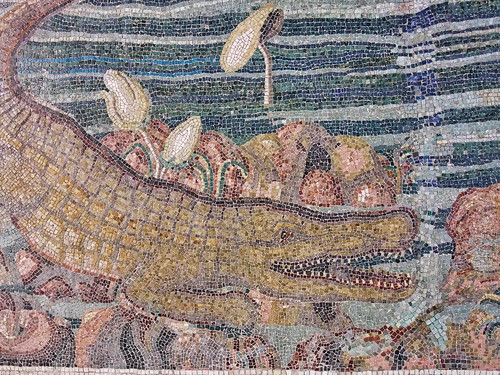
Mosaic Pavement Depicting a Nile Scene from the Maccarani vineyard 
area of the Aventine Hill Roman 2nd century CE. Photographed at the 
Palazzo Massimo by Mary Harrsch. 
Also, at one point in Scarrow's story Cato and Macro chase Ajax into the treacherous marshes of the Egyptian delta and during the pursuit, they hear something swishing past them in the water.  Macro explains it is probably a crocodile but demonstrates no real depth of fear that should have been generated by a close encounter with a ferocious creature depicted in Roman Nilotic mosaics and well known for ripping less fortunate creatures apart in Roman arenas.  It is passages like this that blunt the tension in the narrative.  If Scarrow had one of his protagonists relate a memory of seeing such a beast wreaking devastation during a numachia or something, it would have elevated the tension during the hunt and brought significantly more impact to the novel's conclusion.

I checked out Scarrow's website and he shares it with his brother Alex.  I see Alex has a time travel series with the latest installment being "TimeRiders: The Gates of Rome".  I love time travel stories so I'll have to check it out.  It will be interesting to see if the two brothers differ in their writing styles.

Enhanced by Zemanta
If you enjoyed this post, never miss out on future posts by following me by email!


Sunday, April 8, 2012

Review: Caligula by Douglas Jackson


Several months ago when I began reading "Claudius" by Douglas Jackson, I didn't realize that it was actually the sequel to "Caligula".  Finding "Claudius" well researched with vibrant characters and taut action, I resolved to read "Caligula" as well.

"Caligula" fleshed out the backstory for Rufus, the young animal trainer who eventually became the emperor's elephant handler.  Rufus is the central character in "Caligula", just as he was in "Claudius" and we experience the reign of the emperor Caligula as reflected in the interactions he has with Rufus and with those Rufus holds dear including Fronto, a procuror of beasts for the Roman games who purchases Rufus from a kindly baker, a rebellious gladiator named Cupido who becomes Rufus' best friend, the gladiator's beautiful sister and a diminutive woman chosen by the emperor to be Rufus' wife.

In the opening prologue, Jackson portrays Caligula as an already psychologically disturbed child who tortures little animals as he seeks to learn the limits of physical brutality.   To the best of my knowledge, this is not documented in any ancient sources but it is effective to prepare the reader for some of the scenes of brutality that will follow as the scope of Caligula's brutaliy only increases with the power he acquires as the successor to the dour emperor Tiberius.
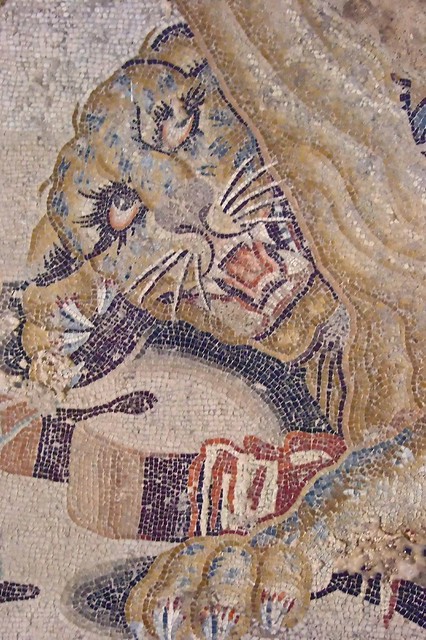
Lion and Leopard Mosaic Detail from 
the House of Doves Pompeii Roman
1st century CE photographed by
Mary Harrsch.

As the novel begins, we learn Rufus was initially sold into slavery by his own father, a former Spanish auxiliary who fails miserably at trying to scratch a living out of a plot of land in North African given to him as part of his discharge compensation from the Roman Army.  Fortunately for Rufus, he is purchased by a kindly Roman baker who teaches him the trade.  But Rufus' real calling is made clear one day when he saves a young girl from a rampaging beast who has escaped from the holding pens of one of the arenas where beast hunts are held to entertain the Roman mob.  His courage in confronting the animal is noticed by Fronto, a procuror and trainer of beasts, who offers to teach Rufus the arts of his trade.  The baker agrees to sell Rufus to Fronto and Rufus' career as an animal trainer begins.

Fronto is a hard task master and Rufus learns some very painful lessons (that, as an animal lover, I found difficult to read).  But Rufus is gifted, both in understanding the nature of the animals he is asked to develop and in recognizing business opportunities in the ever shifting world of the Roman public's imagination.  His gifts do not go unnoticed, however, and soon Fronto, who is childless and had planned to adopt Rufus, is forced to sell him to the new emperor, Gaius Julius Caesar Augustus Germanicus, known behind his back as "Little Boots" (Caligula).

Jackson portrays the mature Caligula as someone who appears to be not openly maniacal but definitely psychologically unstable.  Rufus finds him at times friendly and genuinely interested in the people and events around him.  But these brief periods of lucidity can vanish without warning and then Rufus finds Caligula as dangerous as any beast he has ever faced in the arena.  I think this is a far more realistic portrayal than many past efforts who have presented Caligula as evil incarnate.  My blog post, "Sexual innuendo and character assasination in the ancient world", explains my reasoning on this point.

Jackson does a wonderful job of weaving actual events detailed by Suetonius in his biography of Caligula into the narrative including the construction of a bridge from the Palatine Hill across the forum to the Capitoline which I was unaware of until I read Caligula's biography.  Unfortunately, Fronto's grisly fate is also based on an actual incident detailed by Suetonius as well.  See "The Twelve Caesars" by Suetonius, "The Life of Caligula", Section 27, p449.

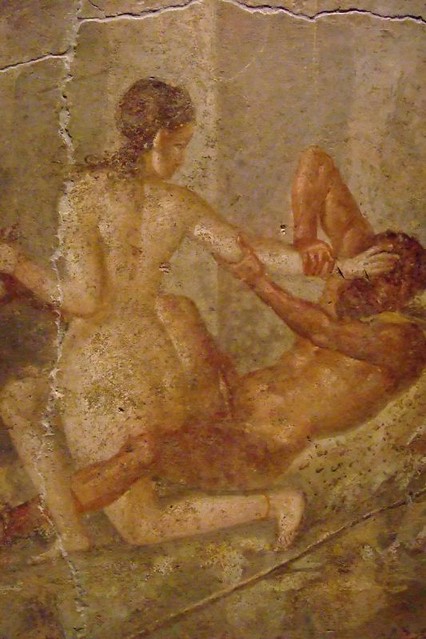
Erotic fresco from Pompeii displayed
 in "The Secret Room" in the Museo 
Archaeologico di Napoli in Naples, Italy. 
Photo by Mary Harrsch.
We also gain insight into the perverse nature of Caligula's sister Druscilla, who summons Rufus to her private chambers, dubbing him her "puppy dog".  Rufus has heard the rumors of an incestuous relationship between Druscilla and her brother and must now fear Caligula's jealous wrath if he discovers Rufus' unwanted nocturnal liaison .

Rufus also learns how everyone in the imperial court becomes players in the "game of thrones" as he is alternately threatened and cajoled by Narcissus, the freedman of Gaius' uncle Claudius, who deftly weaves a web of deceit to entrap any who may become an obstacle to his master's ultimate ascension to the purple.

Through Rufus, Jackson gives us a balanced look at life during the reign of Caligula without resorting to Hollywood-esque over-the-top scenes of licentiousness and bestiality. Jackson clearly illustrates the sense of helplessness, though, that so many slaves in the empire endured when under the control of ruthless and unscrupulous masters.   This helplessness, however, may be frustrating for some readers.

Last year I attended a media arts conference and at a presentation on screenwriting, Sara and Gregory Bernstein emphasized that a compelling protagonist should always be a person who is in control or has the capability to control the events in the plotline.  Rufus, as an imperial slave, however, has absolutely no control over his life or ultimately the lives of most of the significant people in his life.  This may be the reason Jackson's publisher asked Jackson to shift gears a little and develop a totally different character for the  books planned after the publication of "Claudius" even though Jackson's "emperor" series was initially announced as a trilogy and was well received.  (I must point out, though, this is just speculation on my part. )

I do think "Caligula" and "Claudius" vividly demonstrate the high caliber of Jackson's skill as a storyteller and I look forward to reading about the exploits of his new "Hero of Rome",  Tribune Gaius Valerius Verrens. Verrens, commander of the veteran legions at Colonia, must face one of Roman Britain's fiercest rebel leaders, Boudicca of the Iceni.  Judging from the title of the book, he must emerge victorious.  That definitely sounds like a protagonist that can handle whatever a plotline can throw at him.

Related articles:

Blogosphere ~ The Madness of the Emperor Caligula (rogueclassicism.com)
If you enjoyed this post, never miss out on future posts by following me by email!


Friday, April 6, 2012

Augustus or Julius Caesar? Ostia head another puzzle

Lately, I've been working on images I took of the Roman remains of the ancient port of Ostia.  I went to the official website of the archaeological site of Ostia to look through their images to help me identify some of the sculptures I photographed there and stumbled across an image of a head labeled as Augustus:


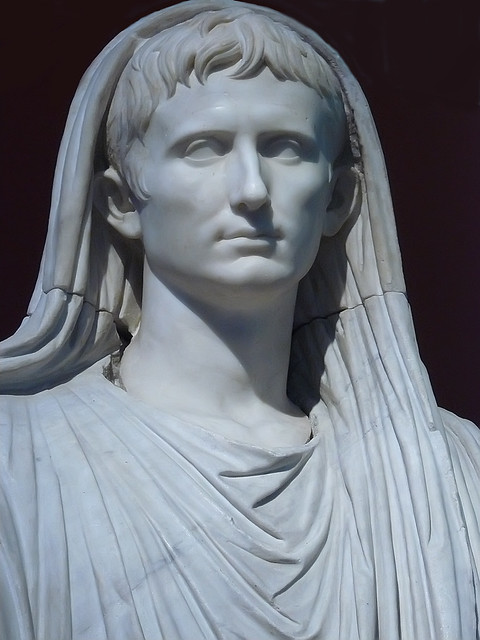
The notes accompanying the image says it was found on the Street of the Vigiles, the firefighters and watchmen of the city.  I realize Augustus is credited with establishing the vigiles in 6 CE after levying a 4% tax on the sale of slaves to fund the new force.  But this portrait head looks more like heads I have seen of Julius Caesar rather than Augustus.  I realize the damage to the frontal part of the forehead makes it difficult to determine the hairline but the hair appears much more sparse and combed forward rather than Augustus' thick locks almost always depicted in a slightly longer, more casual style:

Augustus as Pontifex Maximus photographed
at the Palazzo Massimo in Rome by Mary Harrsch.

I wish I knew if there was any accompanying epigraphic evidence discovered with the head.

I also noticed a portrait head of Hadrian found in a lime kiln:

Head of the Emperor Hadrian found in a lime kiln
 in the Caseggiato del Serapide in Ostia.


It pains me to think of all of the exquisite sculpture that was unceremoniously rendered down to make plaster in the Middle Ages.  What a tragic loss to our cultural heritage!


If you enjoyed this post, never miss out on future posts by following me by email!


Monday, March 12, 2012

Identifying Ancient Art - A game of smoke and mirrors?

History resource article by Mary Harrsch © 2012

Today, I watched a fascinating lecture "Mistaken Identities: How to identify a Roman emperor" by Mary Beard recently delivered at Stanford University.  As a "fan" of Julius Caesar, I thought her critique of a number of heads identified as Caesar over the years was very enlightening.

I also found her overall discussion of the rather tenuous nature of sculpture identification particularly interesting because lately, I have been re-editing a number of images I shot of Roman sculpture at the Capitoline and National Museums in Rome back in 2005.  I had just started my crusade to photograph historical art and make my images freely available to teachers, researchers and students and had not yet developed my current practice of photographing the identification placards in a sequence with the sculpture to enable me to properly identify the artwork once I returned home to my office.  So, on that first trip to Rome, I ended up with dozens of photographs that all I could say for sure were portraits of Roman men or women until I had a chance to research them further to label them properly.

With the internet and our current technology, I naively believed that proper identification would be a relatively straightforward process.  I have since learned that not only is it not straightforward, even what is thought to be accurate identification at the time changes as different scholars apply different interpretations or museums reliant on governmental support become subject to various political agendas seeking some kind of historical confirmation through a culture's art legacy.

It gets even more confusing when identification displayed at a museum differs from the museum's own collections catalog. I recently received a request from a publisher in Denmark for an image I took back in 2007 of a fresco at the Museo Archeologico Nazionale in Naples that, at the time, was labeled "Cleopatra greets the god of the Underworld'.  But, when I looked the image up in the collections book that I purchased at the museum, I noticed that it said it was Io being welcomed upon her arrival to Egypt by the goddess Isis to her sanctuary of Canopos.  The fresco was unearthed in 1764 in the Temple of Isis in Pompeii in a room dubbed the Ekklesiasterion.


The satyr-looking creature bearing up Io looks like it could be Hades but the catalog says it is a river god.  Io is identified by the vestiges of horns she still retains from her time as a heifer.  Isis appears to be dressed in the Greek fashion and holds a cobra coiled around her arm.  The catalog tells us that the painting originated from the court of the Ptolemies in Alexandria "in order to legitimize their dynasty by rooting it in ancient Heraclean and Argive origins which embraced the dual ethnic components of the new kingdom, the Egyptian and the Macedonian".  The fresco is thus dated to the the early Ptolemaic dynasty after a 3rd century BCE prototype .  This all sounds quite carefully researched and definitive.  However, there is no mention of technical dating examinations so I must assume this is educated conjecture.  The only thing that nags at me is the prominent display of the cobra and the knowledge that the fresco was apparently once thought to represent Cleopatra VII in the role of Isis.

In the historical record, Cleopatra VII represented herself as the living embodiment of Isis and the cobra was known to be not only a sacred creature but a pharaonic symbol.  When I check the "king's list" of the Ptolemaic Dynasty, I find a few females mentioned as co-rulers, usually regents for under-age male inheritors, beginning with Cleopatra II Philometora Soteira in 131 BCE, but you really don't find a woman ruling with the trappings of pharaoh until you reach Cleopatra VII in 51 BCE.  So the possibility that Cleopatra VII as Isis is the welcoming figure in the fresco cannot be totally dismissed.  I also can't help but think the widespread publicity surrounding Cleopatra and her death by the bite of a cobra in the 1st century BCE could easily have influenced a Roman artist charged with decorating the walls of a temple to Isis in Pompeii during that period.

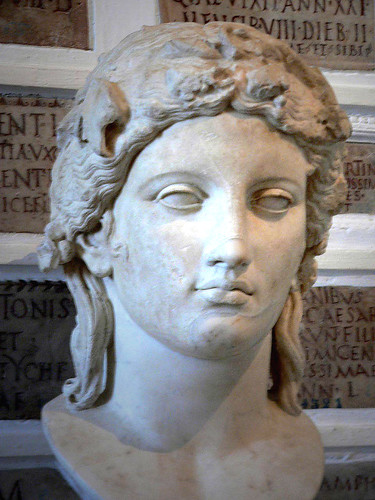
Another confusing identification I encountered recently was a picture of a sculpture said to be Apollo of the Anzio type at the Capitoline Museum:


Call me crazy but it looks like remnants of grapes and grape leaves in the hair which would make me think it was Dionysos.  Many sculptures of Apollo also have an iconic knot in the hair on top of the head so I am baffled by the identification associated with this piece.

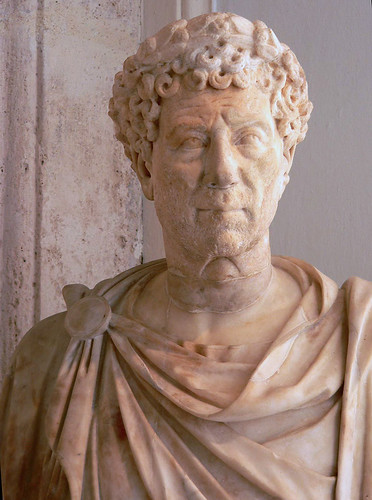
Reviewing my images from the Hall of Emperors in the Capitoline Museum, I came across the following bust:


After reviewing hundreds of images of Roman emperors (or said to be Roman emperors), I cannot find a single one that looks like him.  He appears to be wearing a laurel crown and in 2005 was positioned close to the busts of  Vespasian, Domitian and Titus (based on the photo time stamp).  This would make me think he may have been one of the emperors in the Year of the Four Emperors after the assassination of Nero but I checked images of Otho, Galba and Vitellius and he doesn't resemble any images identified as them.  Although I thought the museum positioned busts in relationship to the sequence of their reigns, this may not be the case either.  So, I would appreciate any information anyone could offer that would help identify this Roman.  


Enhanced by Zemanta
If you enjoyed this post, never miss out on future posts by following me by email!