Thursday, May 6, 2010

80,000 Roman Artifacts final talley for Carlisle Castle Dig

After excavating for over 10 years, researchers have concluded the official dig at Carlisle Castle in the UK.


"Senior executive officer for Oxford Archaeology North, Rachel Newman, said: "The area was very damp 2,000 years ago, and therefore rare evidence survived for how the Romans and their medieval successors lived, in the form of the foundations for their timber buildings, as well as parts of Roman tents and saddles, their shoes, and wooden and leather possessions."

"Many thousands of objects were excavated, including less fragile material, such as pottery, metalwork, both jewellery and everyday utensils, coins, and stone objects."- BBC News

The Roman fort beneath the castle grew from a tent encampment to a town with a self-governing council - the only Roman settlement with "civitas" status in northern England, researchers say.  The Romans also apparently adapted to local culinary tastes as scientists found ample remains of cattle bones that appear to have been salted or smoked for preservation.

At home, Romans seldom ate beef, preferring pork (often in the form of sausage), game animals, fowl or seafood.

For the majority of persons dining in Ancient Rome, meals were centered around corn (grain), oil and wine, and, for the wealthy, different types of exotic foods.   Cereals were the staple food, originally in the form of husked wheat (far) being made into porridge (puls), but later naked wheat (frumentum) was made into bread.  Bread was the single most often eaten food in Ancient Rome, and was sometimes sweetened with honey or cheese and eaten along with sausage, domestic fowl, game, eggs, cheese, fish, or shellfish.
 Fish and oysters were especially popular; meat, particularly pork, was in high demand as well.  Elsewhere in Rome, delicacies, such as snails or dormice, were specially bred.  A variety of cakes, pastries, and tarts was baked commercially and at home, often sweetened with honey.  Vegetables, such as cabbage, parsnips, lettuce, asparagus, onion, garlic, marrows, radishes, lentils, beans, and beats was imported.  Fruits and nuts were also available to the consumer, as was a variety of strongly flavored sauces, spices, and herbs, which became very popular in Roman cuisine. - SPQR Online

 
Particularly exciting was the discovery of this remnant of articulated armor. I'm afraid I'm not an expert on Roman armor but judging from the image, the strips appear to be smaller than the classic lorica segmentata often seen in Hollywood movies.  Perhaps this is a fragment of a set of lorica squamata, a kind of scale armor worn by Roman cavalry.  The heaviest of Roman armor designs, lorica squamata was developed during the late Roman Republic and was usually backed with fabric so it could be pulled on like a shirt.  It's hard to tell from the image, though, if the armor plates were attached to fabric.  The fabric may have deteriorated centuries ago. 

[Image courtesy of BBC News]

To see other examples of Roman armor fragments check out Romanlegions.info

Around the Roman Table: Food and Feasting in Ancient RomeRoman Military Equipment: From The Punic Wars To The Fall Of Rome   The History of Warfare: The Roman Invasions of Britain   An Imperial Possession: Britain in the Roman Empire, 54 BC - AD 409 (Penguin History of Britain)  
If you enjoyed this post, never miss out on future posts by following me by email!


Wednesday, April 7, 2010

Spartacus: Blood and Sand Now Available For Netflix Instant Download

Periodically, I check to see if there are any new movies and television series added to the free (for members) Netflix instant streaming service that I might be interested in and today I could hardly believe my eyes - Spartacus: Blood and Sand showed up in the list before the series has even finished airing on STARZ!  Go STARZ!!

[Image: Andy Whitfield as Spartacus in Spartacus Blood and Sand.  Courtesy of STARZ Entertainment.]

Although I don't agree with the opening disclaimer of the series that it is an accurate depiction of the Roman culture for the time period, I have found the characters increasingly more interesting and the series has drawn me in more and more each week.  I wrote a full review (through episode 10) for Heritage Key.

I know it contains extremely violent graphics and sexual situations but as a technologist I tend to overlook the special effects as just so much CGI and focus on the story.  Star Andy Whitfield as Spartacus does a good job in a very physically demanding role and John Hannah really surprised me as the central villain.  I had only seen him in comedic roles in The Mummy movies with the exception of his performance as a treacherous Roman senator in The Last Legion.  But his performance in that film was almost edited out of existence and what remained barely qualified as a cameo so I didn't really see just how forceful and duplicitous he could be!

Lucy Lawless goes after her role as Batiatus' wife with unreserved gusto as well and I've been introduced to some good performances by several actors I had not seen before too - Manu Bennett as Crixus gets more intense every week and Viva Bianca as Lucretia's friend (and Spartacus' enemy) is absolutely vile!

I read that STARZ had planned to begin shooting season 2 before season 1 even finished up but Andy Whitfield is undergoing treatment for non-Hodgkins lymphoma in New Zealand so the network is waiting for him to recover first.  I do hope they don't change their mind and bail out like HBO did after we have started to care what happens to the characters.  I'm really sick and tired of so-called reality programming and would prefer a little fantasy for a change - even if it is a bit over the top!!

Spartacus: Blood and Sand   Spartacus    The Spartacus War
If you enjoyed this post, never miss out on future posts by following me by email!


Saturday, April 3, 2010

Were Hypatia's astrolabes among the first working models?

As I wait eagerly for the release of the movie "Agora" later this year about the efforts of one of the last academicians of Alexandria, Hypatia, to save its library, I noticed the Smithsonian. just published an interesting article on Hypatia. It mentioned some facts about Hypatia's family and scholarly work that I had not read before.

[Image: Hypatia by Charles William Mitchell, 1885]

I knew she was a mathematician but I didn't realize that she was also a skilled astronomer and actually collaborated with her father, Theon, on several treatises.

"It is thought that Book III of Theon’s version of Ptolemy’s Almagest—the treatise that established the Earth-centric model for the universe that wouldn’t be overturned until the time of Copernicus and Galileo—was actually the work of Hypatia." - Hypatia, Ancient Alexandria's Great Female Scholar, Smithsonian.com


 [Image: Front of  an astrolabe created by Frenchman Jean Fusoris.  Photo courtesy of the Adler Planetarium and Astronomy Museum , Chicago, IL.  The Adler Planetarium houses the largest collection of astrolabes in North America]
If you enjoyed this post, never miss out on future posts by following me by email!


Do new discoveries disprove sacred sex in ancient temples?

It seems that scholars are never quite sure if they should embrace the reports of ancient historian Herodotus or not. Now a controversy has arisen over his statements that the "ugliest of customs", prostitution, actually took place as part of the sacred rituals inside the Temple of Ishtar.

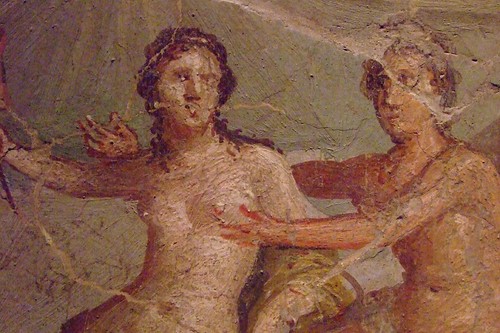
[Image: Ertoic fresco excavated from Pompeii displayed in the 'Secret Room' of the Naples Archaeological Museum.  Photo by Mary Harrsch]

If you've ever visited the "Secret Room" inside the Museo Archaeologico di Napoli in Naples, you will have no doubt that the ancients definitely enjoyed their carnal pleasure. But did they go so far as to make the deflowering of virgins part of their worship of their respective goddesses of love?

The Greek geographer Strabo thought so claiming that Persians living along the shores of the Black Sea dedicated their "virgin daughters," hardly 12 years old, to cult prostitution.

But, a small group of female gender researchers led by American scholar Julia Assante claim it's all the product of overactive male imaginations. (After all, I saw a program this week on Good Morning America about the differences in the male and female brain where a doctor was discussing how the male brain is "marinated" in testoterone!)

More moderate scholars, however, think disavowing all sacred sexual practices goes a bit too far and have expressed their opinions that there were once:

* Temples that operated brothels on the side;

* Temples in which girls held the highest offices of the priesthood, even before their first menstruation;

* Professional harlots who donated their own money to cult sites, such as a site devoted to the goddess "Aphrodite Porne."

But with all those huge buildings dedicated to Ishtar, the goddess of love, there was not a single instance of ritual depravity?

Gernot Wilhelm, an Orientalist at Julis Maximilian University in Würzburg, Germany discovered a 3,300 year-old legal document that recounts how a man delivered his own daughter to the Temple of Ishtar to serve as a Harimtu.

According to the document, the man wanted a loan from the priests and was offering his daughter as collateral.

But what exactly did the pawned daughter do for her new employers? Wilhelm speculates that the young girl worked as a prostitute, "but outside the temple."

As evidence, the professor cites the "Book of Baruch" in the Old Testament. It describes prostitutes standing "along the paths" between the dusty houses of Babylon. They too were somehow associated with a sacred organization. - "Did Prostitution Really Exist in the Temples of Antiquity? by Matthius Schulz
Assante and her colleagues dispute this interpretation, however.  She says a Harimtu was not a prostitute but just a single woman serving as a cult official.

Her reinterpretation of the word Harimtu doesn't make semantic sense, says economic historian Morris Silver. He insists that the Harimtu were clearly "professional prostitutes with cultic connections," who offered a "sexual service" on behalf of the temple. Priests acted as pimps and collected some of the profits. - "Did Prostitution Really Exist in the Temples of Antiquity? by Matthius Schulz
Other scholars point to the accounts of prostitution surrounding the Temple of Aphrodite in Corinth.  Strabo reports the temple owned a stable of over 1,000 prostitutes (I thought he was supposed to be interested in geography?)  Tanja Scheer, a professor of ancient history at the University of Oldenburg in northern Germany blames it all on an ode to Pindar.

"Pindar writes that a wealthy Olympic champion dedicated the temple to a "hundred-limbed" throng of prostitutes in 464 B.C.," Scheer points out,  "It is unlikely that the prostitutes lounged directly at the altar. Instead the wealthy athlete probably offered the temple financial assistance in the form of female slaves."

Scheer bases her theory on the fact that the Athenian statesman Solon taxed prostitutes working in government houses of pleasure in Athens around 590 B.C.. The revenues were subsequently used to build a temple for worshipers of the goddess of love.  Then somehow the construction of the temple became entangled with the source of the money used to build it in subsequent oral histories .
 
Besides, if you take Pindar literally, a "hundred-limbed" throng of prostitutes would have been only a mere 25 if you count all four limbs or 50 if you count just their arms - that seems a far cry from 1,000.

Strabo's sexual fantasies didn't end there, though, either.  He went on to claim that loose women also inhabited the Temple of Amun in Thebes (Egypt) where they served as godly consorts.

Strabo writes, "a maiden of greatest beauty and most illustrious family prostitutes herself, and cohabits with whatever men she wishes until the natural cleansing of her body takes place" (menstruation). 


 Researchers do admit that a recently translated papyrus fragment does refer to young girls in service to the god.

According to the text, girls are permitted to work in the temple until their first menstruation. After that, however, "they are cast out from their duties." - "Did Prostitution Really Exist in the Temples of Antiquity? by Matthius Schulz
So, as they say on that tabloid TV show, "What side are you on?"

 The Myth of Sacred Prostitution in Antiquity   Prostitutes and Courtesans in the Ancient World (Wisconsin Studies in Classics)   Trying Neaira: The True Story of a Courtesan's Scandalous Life in Ancient Greece   Courtesans & Fishcakes: The Consuming Passions of Classical Athens   Courtesans at Table: Gender and Greek Literary Culture in Athenaeus  
If you enjoyed this post, never miss out on future posts by following me by email!


Friday, March 12, 2010

Wallace-Hadrill to present Herculaneum: Living with Catastrophe in Lexington, VA

I see that Dr. Andrew Wallace-Hadrill will present Herculaneum: Living with Catastrophe at Washington and Lee University, Lexington, Virginia on Tuesday, March 23, at 7 p.m. in the Stackhouse Theater.  Oh how I wish I could attend that lecture.  I love living on the west coast but up here in the Pacific Northwest we seldom get the opportunity to hear such world class presentations from classical scholars like Dr. Wallace-Hadrill.

[Image of  Dr. Wallace-Hadrill courtesy of  The Alleghany Journal]

Roman Mosaic found in the ruins of Herculaneum 1st century CE (1)I always enjoy his insight that he has shared in numerous History Channel programs.  Even after all of the years he has spent studying ancient Rome, he still talks about it with such marvelous enthusiasm.  I had hoped to catch a glimpse of him when I visited Herculaneum in October 2007, but no such luck. I did watch some of his researchers working on this beautiful mosaic in a bath complex:

[Image: 1st century CE Roman mosaic found in the ruins of Herculaneum.  Photographed by Mary Harrsch]


Herculaneum is a rather small excavation compared to Pompeii so I was able to explore it in about half a day.  There is much more of the site as yet unexplored but it has been covered by the modern city of Naples so it is doubtful any more of the ancient complex will be unearthed (except perhaps, sadly, by tunneling looters). Much of the artwork originally found in Herculaneum has been removed and placed in the Museo Archaeologico di Napoli but there are still a few pieces in situ.

The day I was there, the Villa di Papiri was closed because of ongoing excavations there.  I would have loved to have seen it, too, so I could compare the layout to the Getty Villa in Malibu that is based upon it.

Herculaneum: Italy's Buried Treasure   Secrets of the Dead - Herculaneum Uncovered   The Library of the Villa dei Papiri at Herculaneum   Vesuvius, A.D. 79: The Destruction of Pompeii and Herculaneum   Antiquity Recovered: The Legacy of Pompeii and Herculaneum (J. Paul Getty Museum)   Houses and Society in Pompeii and Herculaneum   An Introduction to Wall Inscriptions from Pompeii and Herculaneum (From Pompeii and Herculaneum)
If you enjoyed this post, never miss out on future posts by following me by email!