Saturday, September 4, 2010

Sophocles to "Elektra"-fy audiences attending Greek theater exhibit at the Getty

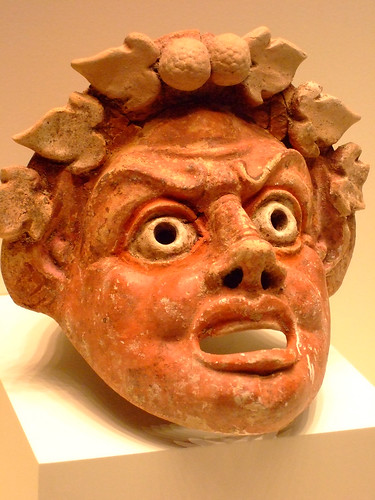
Votive mask of a Satyr Greek made in
the eastern Mediterranean
300-100 BCE
Terracotta. 
Photographed at the Getty
Villa
by Mary Harrsch.

Elaborate costumes, complex choreography, scenic architecture, and the iconic masks of tragedy and comedy depicted in the visual arts of ancient Greece from the 5th to 1st century BCE are the focus of the new exhibit at the Getty Villa, "The Art of Ancient Greek Theater" on display now through January 3, 2011. 

The exhibition is being presented in conjunction with the Getty Villa’s annual outdoor theater performance. This year's production will be Sophocles’ Elektra, directed by Carey Perloff, artistic director of the American Conservatory Theater in San Francisco, with a new translation commissioned from Timberlake Wertenbaker. Performances are scheduled Thursday, Friday, and Saturday evenings, September 9 through October 2, 2010.  A two-day international scholarly conference that will further explore the themes of the exhibition will be held September 24-25, 2010.  In addition, the Villa Theater Lab will present Understanding a Satyr Play: The Trackers on November 19 and 20, 2010.
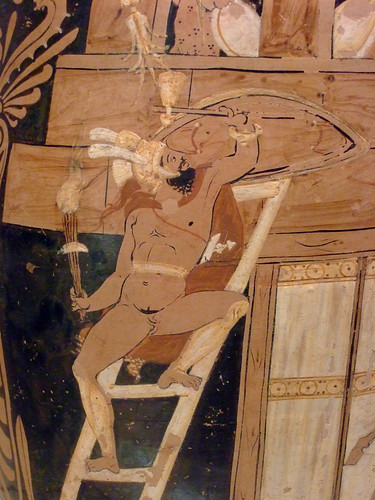
Scene from "Seven Against Thebes" by Aeschylus
depicted on a red-figure storage jar produced
in Campania, Italy about 340 BCE.  Photographed
at the Getty Villa by Mary Harrsch.
“Ancient art and theater share a strong and enduring connection–one that is inspired
by mythology and the social, cultural, and political realities of life in ancient Greece and Rome,” says David Bomford, acting director of the J. Paul Getty Museum. “With this exhibition and our annual production in the outdoor theater, we are delighted to bring ancient theater alive at the Getty Villa and invite our visitors to join us and discover how those themes found in ancient times persist today.”

In addition to the Getty's own collection of Athenian and South Italian vases, marble reliefs, figurines and masks, the exhibit will draw from major collections in Denmark, Australia, New Zealand, France, Germany, Italy, Spain, The Netherlands, Switzerland, the United Kingdom and elsewhere in the United States.

I found a humorous description of the history of Greek comedy by Brander Matthews in "The Development of Drama" published in 1912:

"Comedy seems to have sprung into being at the vintage-festival of the Greek villagers, when all was jovial gaiety and jesting license in honor of Dionysus. "On public occasions," so a recent historian of the origin of art has reminded us, "the common mood, whether joy or sorrow, is often communicated even to those who were originally possessed by the opposite feeling; and so powerful is infection of excitement that a sober man will join in the antics of his drunken comrades--yeilding to a drunkenness by induction." And these seasons of contagious revelry were exactly suited to a development of the double desire of mankind for personation--one man seeking to get outside of his own individuality and to assume a character not his own, while another finds his satisfaction rather in the observation of this simulation, in being a sympathetic spectator when actions are represented not proper to the actor's own character.

So it came to pass that there were companies of young fellows, often disguised grossly as beasts or birds, who broke out into riotous phallic dances, enjoyed equally by those who looked on and by those who took part. In time the dancers grouped themselves in rival bands, the leaders of which indulged in a give-and-take of banter and repartee, certainly vulgar and personal, and probably as direct and artless as the chop-logic dialogues of the medieval quack-doctor and his jack-pudding, or of the modern ring-master and circus clown. The happy improvisation of this carnival spirit which happened to delight the crowd one year would surely be repeated the next year deliberately, perhaps only to evoke an unexpected retort with which it would thereafter be conjoined in what might prove to be the nucleus of a comic scene of some length. Thus a species would tend to appear, as the tradition was handed down from season to season, enriching itself constantly with the accretions of every venturesome jester. However frail this framework might be, it would be likely to contain a rough realization of the more obvious types of rural character; and almost from the beginning there would be abundant and irreverent parody of heroic legend and of religious myth." - Brander Matthews, The Development of Drama
  Perhaps because of its riotous origins, Greek theater, like other aspects of Greek culture, was only tentatively embraced by the Romans.  Until the Theater of Pompey was built in 55 BCE, theaters were temporary structures of wood that were erected before scheduled performances and torn down afterwards. The construction of two stone temples had been attempted in 179 and 174 BCE but never completed.  Then a third temple was begun in 154 BCE but the consul P. Scipio Nasica, declared the structure to be "undesirable" and "harmful to public morals" (Livy, Periochae 48.68) and had the construction torn down.  Even in the late Republic, Pompey was forced to disguise his theater as a temple to Venus. Until 145 BCE audiences were not even allowed to sit while attending a theatrical performance.

A decree of the Roman Senate forbade sitting at theatrical performances "so that the manly behavior of standing might be known as proper to the Roman people for the relaxation of their spirits (Valerius Maximus, Memorable Words and Deeds 2.4.2)." - Introduction to Greek and Roman Comedy
There were several key differences in both the construction of  theaters and in the structure of the performances presented to Roman audiences.

The Roman theater, although similar in form to the Greek theater, developed a magnificence and splendor in keeping with Rome's imperial status.  This grandeur is most evident in the stage building, which was raised to the height of the seating area.  Thus the stage building was normally three stories high in comparison with the two stories of the skene in later Greek theaters.   The orchestra in the Roman theater for the most part became a seating area because of the virtual disappearance of the chorus from Roman drama." - Introduction to Greek and Roman Comedy
I found a rather anti-Roman comparison of Greek and Roman theater written by Wilhelm Schlegel in 1904.  Like many Victorian-era classicists of the period, he appears to idolize the cultural contributions of the Greeks and consider the Roman poets and playwrights little more than copyists!

Other deviations from the Grecian mode of representation were also sanctioned, which can hardly be considered as improvements. At the very first introduction of the regular drama, Livius Andronicus, a Greek by birth, and the first tragic poet and actor of Rome, in his monodies (lyrical pieces which were sung by a single person, and not by the whole chorus), separated the song from the mimetic dancing, the latter only remaining to the actor, in whose stead a boy, standing beside the flute-player, accompanied him with his voice. Among the Greeks, in better times, the tragic singing, and the accompanying rhythmical gestures, were so simple, that a single person was able to do at the same time ample justice to both. The Romans, however, it would seem, preferred separate excellence to harmonious unity. Hence arose, at an after period, their fondness for pantomime, of which the art was carried to the greatest perfection in the time of Augustus. From the names of the most celebrated of the performers, Pylades, Bathyllus, &c., it would appear that it was the Greeks that practiced this mute eloquence in Rome; and the lyric pieces which were expressed by their dances were also delivered in Greek. Lastly, Roscius frequently played without a mask, and in this respect probably he did not stand alone; but, as far as we know, there never was any instance of it among the Greeks. The alteration in question might be favourable to the more brilliant display of his own skill, and the Romans, who were pleased with it, showed here also that they had a higher relish for the disproportionate and prominant talents of a virtuoso, than for the harmonious impression of a work of art considered as a whole. - Lectures on Dramatic Art and Literature by Wilhelm Schlegel

To see a variety of both Greek and Roman art objects embellished with theatrical masks or scenes from theatrical performances, I encourage you to view the following slideshow of artifacts I have photographed at the Getty as well as the British Museum, The Louvre, and various museums in Italy:


For those of you who can visit the Getty Villa in November, I highly recommend that you attend one of the performances of "Elektra" in the Villa's reproduction of a Greek theater.

The story of Elektra carries forward the tragic history of the House of Atreus.  Years after the bloody murder of King Agamemnon, his widow, Clytemnestra, and her lover Aegisthus, rule the city with an iron hand, while their daughter Elektra prays to the gods that her exiled brother Orestes might return to avenge their father's death.  Believed to have been written near the end of Sophocles' life, Elektra embodies the playwright's most profound portrait of the endurance of the human spirit, brilliantly ablaze with the warring, inner flames of hope and despair. - Elektra Director, Carey Purloff
Actually, both Sophocles and Euripedes wrote plays about Elektra (sometimes spelled Electra) the very same year.  A modern reviewer compares the two versions, pointing out that in his opinion Sophocles' characters adhere to societal values regardless of the personal consequences where Euripedes appears to advocate the assessment of alternative solutions and a degree of thought independent of societal dictates. 

I see next year the Getty will present "The Trojan Women".  I had the privilege of attending a performance of a modern adaptation of "The Trojan Women" presented by the drama department at the University of Oregon at their Robinson Theater a couple of years ago and enjoyed it immensely.

I learned even more fascinating information about Greek theater when I listened to  The Teaching Company's excellent lecture series on Greek tragedy presented by Professor Elizabeth Vandiver of Whitman College.  I found it absolutely riveting!

The Art of Ancient Greek Theater    A Short Introduction to the Ancient Greek Theater: Revised Edition   Classical Tragedy - Greek and Roman: Eight Plays in Authoriative Modern Translations  Seven Plays in English Verse   Sophocles: The Complete Plays (Signet Classics)   Ten Plays by Euripides   Aeschylus I: Oresteia: Agamemnon, The Libation Bearers, The Eumenides    Aristophanes: The Complete Plays   The Pot of Gold and Other Plays (Classics)   The Roman Theatre and its Audience   
If you enjoyed this post, never miss out on future posts by following me by email!


Thursday, August 19, 2010

Turkish documentary to retrace sea voyage of Aeneas

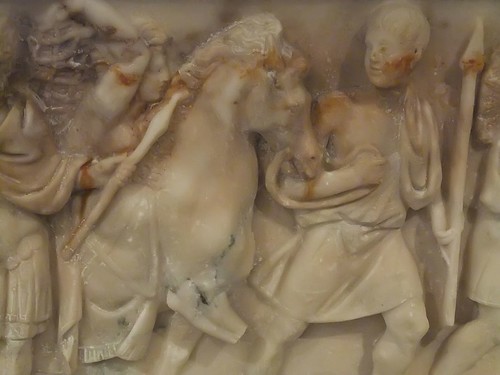
Roman Sarcophagus Depicting Scenes from the Aeneid
2nd century CE from the Giustiniana area along the
Via Cassia Rome.  Photographed at the National Museum
in Rome, Italy by Mary Harrsch.
In an effort to promote the parallel study of the post- Trojan period in Turkey and Italy, Turkish archaeologists are planning to produce a documentary film about the sea journey of Aeneas  from Antandrus in Turkey to the Latium region of Italy.

“A ship, which we’ll name ‘Tempest,’ will set off from Altınoluk and follow the route that was taken by Aeneas’ band in 700 B.C. using sails and oars only,” said Excavation Chairman Gürcan Polat in detailing the plans for the journey from the northwestern Turkish province to Italy.

The ship to be used in re-creating Aeneas’ journey will be built in the style of the post-Trojan period, the excavation coordinator said.

“Aeneas’ experiences in every place he passed will be dramatically re-created and documented. In this way, we will have a very significant historical documentary,” said Polat, detailing plans for a documentary film to accompany the seafarers. “I hope it will also contribute to the promotion of both Antandrus and Turkey abroad.” - Turkey Daily News & Economic Review
Homer tells us that Antandrus was among the 11 cities and 12 islands conquered by Achilles during the Trojan War.


Aristotle states that Antandrus was occupied by the Cimmerians about 700 BCE and was referred to as Kimmeris for a hundred years during their occupation.


Antandrus was later colonized by the Greeks on the north side of the Adramyttian Gulf in the Troad region of Anatolia, near the modern village of Avcilar in Turkey in the 5th century BCE but scholars disagree on the founders.

"Strabo, quoting the poet Alcaeus, mentions the Leleges (Geography, 13.1.51), Herodotus believed the first settlers were Pelasgians (Histories, 7.42), and Thucydides mentions the Aeolians (History of the Peloponnesian War, 8.108)." - Livius.org

After participating in the Ionian Revolt, Antandrus later joined the Delian League.

During the Peloponnesian War, exiles from Lesbos captured the city, used it as base to recapture Mytilene, but were expelled by the Athenians, who garrisoned the place (Diodorus, World History, 12.72.2). - Livius.org

During the Corinthian War, it was used as a strategic naval base. 

The economy of Antandrus was based on the sale of timber from Ida Mountains.

In Search of a Homeland: The Story of the Aeneid   Vergil's Aeneid: Hero War Humanity   Art of the Aeneid (Bristol Classical Paperbacks.)   In Search of the Trojan War, Updated edition   Troy and its Remains: A Narrative of Researches and Discoveries Made on the Site of Ilium, and in the Trojan Plain (Cambridge Library Collection - Archaeology)   The Modern Scholar Archaeology and the Iliad: The Trojan War in Homer and History   The Trojan War: Literature and Legends from the Bronze Age to the Present
If you enjoyed this post, never miss out on future posts by following me by email!


Wednesday, July 28, 2010

Ben Hur Live spectacle comes to US in Fall 2010

The stylized naval battle in Ben Hur Live.  Image courtesy of
Art Concerts.
Somehow, I missed all the hoopla about Ben Hur Live when it made its debut in September 2009 in London's 02 arena.  So I was surprised by the announcement today that Russell Crowe has agreed to narrate the spectacle when it is presented in Sydney, Australia.  I immediately Googled the show and retrieved quite a few, unfortunately acerbic, critical reviews of the production when it was presented in London.  I must admit, though, that the images of the chariot race, naval battle and formations of staunch legionaries looked intriguing.

It took quite a few searches before I finally found a reference to the show's tour calendar indicating there would be presentations in the U.S. starting in the fall of 2010.  This sprawling spectacle includes a cast of over 400 along with over 40 horses.  Some critics complained that it didn't leave enough to the imagination or was just too "over the top", but the Times reviewer, Benedict Nightingale, was a little more charitable:


Here’s a show in the Victorian tradition of plays that brought onstage shipwrecks, volcanos, earthquakes, forest fires, collapsing bridges, floods and, in The Ruling Passion at Drury Lane, a balloon that rose from the Crystal Palace and dropped into the Channel, where its occupants, including the heroine and an escaped lunatic, were rescued by lifeboat.

The visual successes include a Jerusalem so crammed with people, from jugglers to beggars, grandees to belly dancers, that it might have been painted by Brueghel, and a battle in which skeletal ships packed with vermicular oarsmen are somewhat anachronistically attacked by what look like Somali pirates on beach-buggies. The Roman legionnaires, too, are genuinely scary as they menacingly parade in their phalanxes, even more so than gladiators who use swords, rope, and what look like long tuning forks in a well-orchestrated display of violence.

This isn’t a show that will displace the film in the memory, or make the DVD redundant, but it’s not silly, not naff, not a waste of your time and the O2’s space. I rather enjoyed it. - Benedict Nightingale, Times Online

I looked through the Times article's slideshow of images and I think I would rather enjoy it myself!  I must admit I'm not too keen on the dialog being delivered in Latin and Aramaic but I'm rather used to watching foreign films and getting the gist of what is going on even without reading the subtitles and, of course, I've watched the film version of Ben Hur so many times I know the story by heart anyway.

When I was in Rome last year, my friend and I went to the cinema one night and watched Clint Eastwood in Gran Torino dubbed in Italian with no subtitles.  Later after I returned home I ordered it from Netflix and watched the original English version and wasn't mistaken about any assumptions I had made watching it in Rome.  So I think I can enjoy Ben Hur Live, even if I can't understand the dialog.  I'm sure the production company will get someone suitable here to narrate.  It would be fantastic if Russell Crowe would do the narration for the US tour but that's probably more than I can hope for.

Like most topics, I was able to find quite a few short clips of the show when it appeared in London on You Tube.  Here is one of the better ones:


This interview with Steve Copeland about his work on the show's music has a lot of nice still images as well:


I didn't find a list of US venues although from the looks of the show it obviously requires quite a large arena space. I do hope at least one west coast performance is planned. I would happily fly to San Francisco or L.A. to see it.  After all, a person needs to see at least one Roman spectacle in their lifetime, right?

Ben-Hur (Four-Disc Collector's Edition)   Ben Hur (Animated)   Ben-Hur: A Tale of the Christ    
If you enjoyed this post, never miss out on future posts by following me by email!


Thursday, July 22, 2010

Could New MIT program use Pyrgi Tablets to Decipher Etruscan?

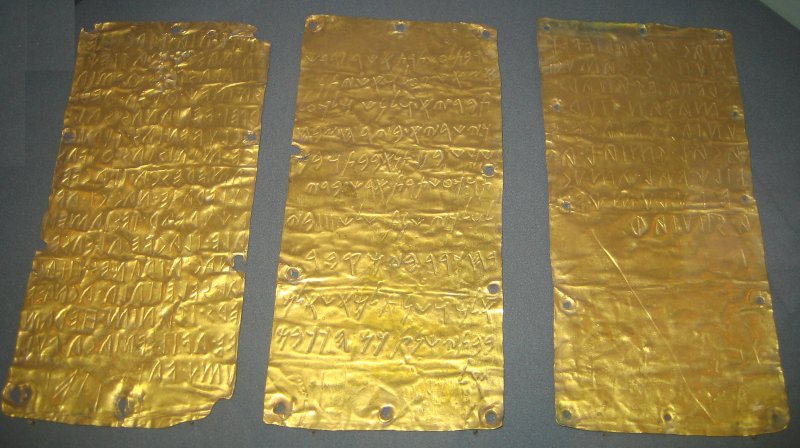
The Pyrgi tablets contain a treatise inscribed in both
Etruscan and Phoenician script.  Image courtesy of
Wikimedia user Pufacz.

Being a technology professional I couldn't help my excitement when I read that a new computer program developed at MIT had been used to decipher Ugarit, an ancient language used in Syria over three thousand years ago. Even more amazing is that the program was able to do so after only a few hours. Linguists have spent years trying to decipher it!


The program is designed to compare an unknown language with a language known to be related to it. In this case scientists set the known related language to Hebrew.


"The system looks for commonly used symbols in the two languages and gradually refines its mapping of the alphabet until it can go no further. The Ugaritic alphabet has 30 letters, and the system correctly mapped 29 of them to their Hebrew counterparts."

"Of the words that the two languages shared the program was able to correctly identify 60 per cent of them." - Read more


Critics point out that some as-yet undeciphered scripts have no known related languages so the program would not be of much use for them.  But leading researcher Regina Barzilay thinks that by scanning multiple languages at once the program could draw logical conclusions from contextual references.

Etruscan Architectural Antefix depicting a
Maenad and a Satyr 500-475 BCE. Photographed
at the Getty Villa by Mary Harrsch.

Perhaps if they used epigraphic examples from similar types of excavation sites that would increase the likelihood that the inscriptions would be discussing similar topics. For example, if they used inscriptions from tablets all found near granaries or inscriptions all found on funerary objects in tombs it may help to increase the contextual similarities. If they further limited inscriptions to those found in similar sites from roughly equivalent time periods that would narrow the comparisons even further. This may also mean that comparisons could be made with languages existing at the same time period but not necessarily from a related language group.

In the Etruscan Museum in Rome housed in the Villa Giulia, there is a treatise inscribed on the Pyrgi tablets in both Etruscan and Phoenician. Although they are not related languages, they are both obviously talking about the same thing. Perhaps their inscriptions could be used as a test with the new software.


Other critics have pointed out that the program really does not have a way to determine the beginning or ending of words either. This can be a serious problem as Etruscan did not use spacing or punctuation until the sixth century BCE and then dots or colons may have also been used to separate syllables as well as words and sentences.

It's too bad all of the emperor Claudius' work on Etruscan have been lost over the centuries.


Only a few educated Romans with antiquarian interests, such as Varro, could read Etruscan. The last person known to have been able to read it was the Roman emperor Claudius (10 BC – AD 54), who — in the context of his work in twenty books about the Etruscans, Tyrrenikà (now lost) — compiled a dictionary (also lost) by interviewing the last few elderly rustics who still spoke the language. Urgulanilla, his first wife, was Etruscan.[3]

Livy and Cicero were both aware that highly specialized Etruscan religious rites were codified in several sets of books written in Etruscan under the generic Latin title Etrusca Disciplina. The Libri Haruspicini dealt with divination from the entrails of the sacrificed animal, the Libri Fulgurales expounded the art of divination by observing lightning. A third set, the Libri Rituales, would have provided us with the key to Etruscan civilization: its wider scope embraced Etruscan standards of social and political life as well as ritual practices. According to the 4th century Latin writer Servius, a fourth set of Etruscan books existed, dealing with animal gods, but it is probably unlikely that any contemporary scholar could have read Etruscan at such a late date. The single surviving Etruscan book, Liber Linteus, being written on linen, survived only by being used as mummy wrappings. - Wikipedia
Now that we have even better technology to analyze mummy wrappings and scrolls that were reused in the Middle Ages as well maybe some of Claudius' work will be found in the future.

The Atlas of Languages: The Origin and Development of Languages Throughout the World (Facts on File Library of Language and Literature Series)   The Power of Babel: A Natural History of Language   Etruscan Civilization: A Cultural History   The Etruscan Language: An Introduction, Revised Editon   Claudius
If you enjoyed this post, never miss out on future posts by following me by email!


Monday, July 19, 2010

Viewing Frescoes from Agrippa's Villa Farnesina Like The Ancient Romans

I see that the National Museum at the Palazzo Massimo has added a new dynamic lighting system to the display of the frescoes recovered from the Villa Farnesina, thought to have been one of the residences of Augustus' friend, general and admiral, Agrippa.

"A sophisticated and unique lighting system that recreates daylight hours from dusk to dawn in 100-second cycles lets visitors hone in on the details of the frescoes and vault stuccoes, which depict mythological scenes as well as more mundane activities. “It’s akin to seeing through the eyes of ancient Romans,” said Stefano Cacciapaglia, one of the architects who worked on the project." - More: New York Times

I wish I could have examined the frescoes with the new system when I visited the National Museum back in March 2009.   I was particularly impressed with the detail the artist captured in the faces, still discernible after more than 2000 years.

If you enjoyed this post, never miss out on future posts by following me by email!