Sunday, December 20, 2009

Exploring 1st - 4th century Roman villas in Brescia sounds fascinating!


I received a touristy little news item about the northern Italian town of Brescia that caught my interest.  The article mentioned that the area contained the largest Roman excavation in northern Italy so, of course, I had to read more about it.  I learned that Brescia, was once known as Brixia.

[Image: Mosaic floor of a 1st - 4th century Roman villa preserved at the Brescia Musei, Brescia, Italy.]

"Different mythological versions of the foundation of Brescia exist: one assigns it to Hercules, while another attributes its foundation to Altilia ("the other Ilium") by a fugitive from the siege of Troy. According to a further myth, the founder was the king of the Ligures Cidnus, who had invaded the Padan Plain in the late Bronze Age. Scholars attribute the foundation to the Etruscans." - Wikipedia

The Etruscans fell to the  Gallic Cenomani, allies of the Insubres, in the 4th century BCE.  The Celts succumbed to the Romans in 225 BCE.   But the Celts were not all satisfied with Roman rule and became part of a Celtic confederation allied with the Carthaginians in 202 BCE during the 2nd Punic War.

"...but, after a secret agreement, [Brixia] changed side and attacked the Insubres by surprise, destroying them. Subsequently the city and the tribe entered the Roman world peacefully as faithful allies, maintaining a certain administrative freedom. In 89 BC Brixia was recognized as civitas ("city") and in 41 BC its inhabitants received Roman citizenship. Augustus founded a civil (not military) colony there in 27 BC, and he and Tiberius constructed an aqueduct to supply it. The Roman Brixia had at least three temples, an aqueduct, an amphitheater, a forum with another temple built under Vespasianus, and some baths.

When Constantine advanced against Maxentius in 312, an engagement took place at Brixia in which the enemy was forced to retreat as far as Verona. In 402 the city was ravaged by the Visigoths of Alaric I. During the invasion of the Huns under Attila, the city was again besieged and sacked in 452 while, some forty years later, it was one of the first conquests of the Gothic general Theoderic the Great in his war against Odoacer." - Wikipedia

Republican-era buildings were discovered there in the 19th century under the remnants of the Capitolium, the temple built by the Emperor Vespasian.  Artifacts recovered from these excavations include Celtic arms, Roman portrait sculpture, frescoes and mosaics.  The Santa Giulia City Museum houses these discoveries as well as a collection of preserved Roman townhouses from the 1st to 4th century CE.

I'm also a big fan of armor collections and I see that the castle portion of the Museum houses an arms collection in the keep.  Over 580 swords, firearms and suits of armour, over half of the 1090 items bequeathed by industrialist Luigi Marzoli, are displayed in ten exhibit rooms.  The oldest item is a sword from the 13th century and one of the rarest is a large Venetian helmet and under-helmet with visor in the shape of a dog’s muzzle.

I had a wonderful time photographing the extensive armor collection at the Metropolitan Museum of Art in New York several years ago.  I would love to add images of  Brescia's marvelous collection to my Flickr set! I haven't yet visited Venice and I was really anxious to explore Ravenna someday too.  It looks like I need to plan a major expedition to northern Italy!


Houses, Villas, and Palaces in the Roman World     Roman Villas in Central Italy (Columbia Studies in the Classical Tradition)     Arms & Armor (DK Eyewitness Books)   Medieval Arms and Armor: A Pictorial Archive (Dover Pictorial Archive Series)   Vespasian   The Architecture of Roman Temples: The Republic to the Middle Empire
If you enjoyed this post, never miss out on future posts by following me by email!


Wednesday, November 18, 2009

Compassion for Pompeiian Dogs Sparks New Project


Although mosaics of ancient Pompeii proclaim the Roman equivalent of "Beware of Dog", I found the current canine residents of the remains of Pompeii to be rather docile creatures who prefer to snooze on the warm ancient paving stones of the archaeological site rather than chase away tourists. So, I was glad to read that the superintendent of the Pompeii has launched an effort to not only care for the dogs, but actively seek "forever" homes for them.

"They sleep under ancient Roman frescoes and walk on priceless mosaic floors, but they are far from living a privileged life. They are the dogs of Pompeii -- sick, starving, dirty and scruffy stray dogs who wander through the ruins of the volcano stricken Roman town.

[Image: A canine resident of Pompeii still waits patiently for someone to take them home. Photo by Mary Harrsch.]

The poor animals have been living in the ancient Roman town for decades, marking the territory by urinating on the ancient walls, and relying on compassionate tourists for food and water.

"Stray dogs have given Pompeii a bad image, but things are going to change. From now on, dogs will have their own identity and dignity and will be taken care of," Pompeii's emergency commissioner Marcello Fiori said at a press conference on Monday. - More: Discovery News

If you enjoyed this post, never miss out on future posts by following me by email!


Friday, October 23, 2009

Bust of Caracalla goes on the auction block


A bust of Lucius Septimius Bassianus, better known as Caracalla, a nickname thought to be derived from a hooded Gallic cloak that he regularly wore, is slated to be auctioned at Bonhams Antiquities in London on October 28, 2009. The sculpture with its characteristic frown is expected to bring up to ₤250,000.

[Image: Bust of Caracalla. Photo courtesy of Bonhams]

The Roman marble bust of the Emperor Caracalla depicts him turning sharply to his left, his face contorted in a characteristic forbidding frown, his creased forehead with curving eyebrows drawn together, the eyes deep-set with articulated pupils. The nose is broad with a short moustache above his downturned mouth, his strong chin cleft and covered with a short curling beard, his hair composed of tight curls with drilling, the thick sideburns joining his beard. He wears a paludamentum draped around his shoulders.

This bust is of the 'Sole-Ruler' type, dating to the period after he murdered his brother and co-emperor Geta. Other examples of this type are in the Museo Capitolino Montemartini, (inv. 2310), the Museo Archeologico Nazionale di Napoli, the Vatican Museum and the British Museum. A head in the Acropolis Museum, Athens has some of the closest stylistic similarities. - Culturekiosque Art and Archaeology News


Caracalla's, features reflect his mixed Punic/Berber and Syrian descent, being the son of Roman emperor, Septemius Severus who hailed from Leptis Magna in Libya. I think his face also reflects the savagery that marked his reign from 198 (co-ruling with his father) to 217 CE. In addition to assassinating his brother, Geta, the family of his former father-in-law Gaius Fulvius Plautianus, his wife Fulvia Plautilla and her brother, he slaughtered over 20,000 hapless citizens of Alexandria when rumors reached him that the people there had been mocking his claim that he killed his brother in self defense.

Caracalla was equally brutal and duplicitous in his foreign affairs. In 216 CE, he triggered a war with Parthia after accepting a marriage proposal then slaughtering the guests who arrived for the wedding celebration.

He made only two relatively positive contributions to the people of the Rome and the empire. In 212 CE, he issued the Constitutio Antoninian that granted citizenship to all free men in the Roman Empire. Before this time, only inhabitants of Italia or their descendants living in provinces along with a small number of nobles and client kings held full citizenship. Caracalla issued this edict to increase the number of people subject to more Roman taxes to replenish his imperial coffers. He may have also used the legal device to increase the number of men who could serve as legionaries rather than mere auxiliaries in the Roman Army. Scholars point to this event as one of the reasons the professional Roman military became barbarized. Also, With Roman citizenship no longer an enticement for enlistment, this edict may have inadvertently led to the recruiting difficulties of the Roman army by the end of the 3rd century CE.

Between 212 and 216 CE, Caracalla constructed his second contribution, the Baths of Caracalla, a complex of buildings covering over 33 acres. Its remnants are now viewed by millions of tourists each year approaching Rome on the freeway from the Leonardo da Vinci - Fiumicino airport. It is also a stop on the Archaeology bus tour that picks up visitors at Termini Station.

The massive structure not only included the requisite cold, warm and hot bathing facilities that accomodated up to 16,000 bathers, but libraries, gymnasia, shops, and colossal statues including a sculpture representing the myth of Dirce.

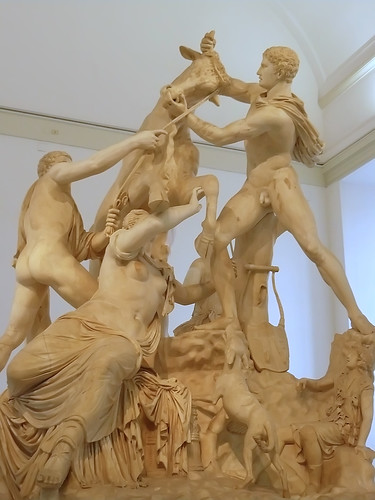
[Image: Farnese bull sculpture group depicts the legend of Dirce who was tied to a wild bull as punishment for abusing the mother of Amphion and Zethus. Photographed at the Museo Archaeologico di Napoli, Naples, Italy by Mary Harrsch]

Dirce was the wife of Lycus, king of Thebes. Dirce's niece, Antiope, was seduced by the ever amorous Zeus, king of the gods, and impregnated. Antiope's father was furious with her so she fled to King Epopeus of Sicyon who took her for his wife. Her father, killed himself in disgrace but before he died he asked his brother, King Lycus to avenge him by punishing King Epopeus and Antiope. King Lycus marched on Sicyon and slew King Epopeus then gave the hapless Antiope to his wife Dirce to serve as her maid. Dirce hated her niece, probably for her beauty, since that is often considered a normal female rationale in Greek mythology and usually the reason women attracted Zeus, and treated her cruelly. Dirce had given birth to twin boys, Amphion and Zethus, after King Lycus captured her, and, who, like many offspring of Greek deities, were exposed but found and raised by a kindly shepherd.

One day, Antiope escaped her cruel mistress and found her way to the cave where her sons lived. When she explained who she was and what had happened to her, Amphion and Zethus rose up and slew King Lycus and tied Dirce to the horns of a wild bull. After her gruesome death, Dirce was cast into a spring on Mount Cithaeron or, as some versions relate, she was transformed into a spring by the god Dionysos because of her devoted worship of him.

Unfortunately, this myth was supposedly recreated in the Roman arena during Christian persecutions, although Christian persecutions did not occur during Caracalla's reign, with the exception of limited activities in North Africa.

[Image: Christian Dirce by Henryk Siemiradzki (1843–1902), Warsaw National Museum. Courtesy of Wikimedia Commons]

The Dirce sculpture is now known as the Farnese Bull after it was excavated from the Baths of Caracalla in 1546 by a team funded by Pope Paul III who was looking for artwork to place in his new residence, the Farnese Palace. It eventually wound up in the Museo Archaeologico di Napoli in Naples where it can be seen today.

When I think of the Baths of Caracalla, I also envision the pleasant scene of beautiful Roman women lounging before the luxurious pools as depicted by one of my favorite artists, Sir Lawrence Alma-Tadema. Actually, the women's clothing is a little more Victorian than it should be and the scene depicts men bathing alongside women that was not accurate either but you get a definite sense of the size and sumptuousness of the halls and how much bathing was viewed as a shared social experience in the Roman world.

[Image: The Baths of Caracalla by Sir Lawrence Alma-Tadema, 1899, Oil on canvas, courtesy of The Art Renewal Center]

If you enjoyed this post, never miss out on future posts by following me by email!


Monday, September 28, 2009

Possible Victims of Trojan War unearthed in Turkey


A team from the University of Tubingen, led by Ernst Pernicka, have uncovered a pair of skeletons in the ancient city of Troy near ceramic fragments dated to the period of the Trojan War. It is discoveries like this that remind us how important literature like Homer's Iliad is to understanding our ancient past. It will really blow me away if they find a skeleton of an infant with its head crushed. We could then be looking at the only corporeal remnant of the famous Hector, trainer of horses!

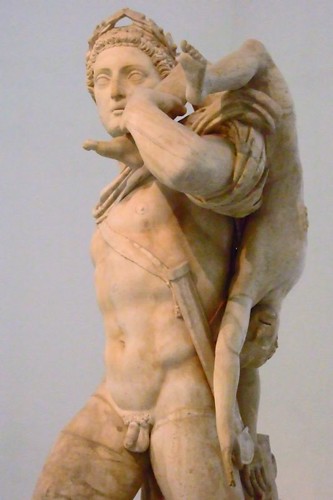
[Image - Warrior with captured child, Roman copy of 3rd century BCE Greek original. Photographed at the Museo Archaeologico di Napoli, Naples, Italy by Mary Harrsch.]

This discovery, though, also raises the question about disposal of "enemy" dead after a catastrophic sack. Both the Greeks and the Trojans at the time practiced cremation. If skeletons are found that could have been retrieved for burial, it makes a person wonder if the Greeks not only violated religious taboos by slaughtering people who had fled to the temples for sanctuary, but did not grant the defeated and enslaved survivors the courtesy of properly burying their dead either. Perhaps the violent deaths later visited upon the Mycenaean victors were just desserts after all.

"Pernicka said pottery found near the bodies, which had their lower parts missing, was confirmed to be from 1,200 BC, but added the couple could have been buried 400 years later in a burial site in what archaeologists call Troy VI or Troy VII, different layers of ruins at Troy. professor of archaeometry who is leading excavations on the site in northwestern Turkey, said the bodies were found near a defense line within the city built in the late Bronze age.

The discovery could add to evidence that Troy's lower area was bigger in the late Bronze Age than previously thought, changing scholars' perceptions about the city of the "Iliad."

"If the remains are confirmed to be from 1,200 B.C. it would coincide with the Trojan war period. These people were buried near a mote. We are conducting radiocarbon testing, but the finding is electrifying," Pernicka told Reuters in a telephone interview.

Pernicka said pottery found near the bodies, which had their lower parts missing, was confirmed to be from 1,200 BC, but added the couple could have been buried 400 years later in a burial site in what archaeologists call Troy VI or Troy VII, different layers of ruins at Troy.

If you enjoyed this post, never miss out on future posts by following me by email!


Friday, September 25, 2009

Pompeii exhibit nears its end in Los Angeles


The fantastic exhibit "Pompeii and the Roman Villa: Art and Culture Along the Bay of Naples" at the Los Angeles County Museum of Art will be closing soon (October 4, 2009). If you haven't seen it yet, I would heartily recommend it.

I had the opportunity to see this exhibit last month while I was in the area attending a donor fund raising event for the Gallery of Historical Figures. I was particularly fascinated by the emphasis on archaism in Roman art, so much so that I wrote an extensive article about it for Heritage Key. Heritage Key is a new website that came online in June 2009 that focuses on the ancient and prehistoric world before 600 CE. The executive director, Jon Himoff, asked if I would be interested in writing articles for them and I agreed. If you haven't explored their website yet, I would encourage you to do so as they not only have some fascinating articles to read but have a virtual recreation of King Tut's tomb that you explore using an interface very similar to the one used in Second Life.

[Image: Bronze Replica of a Wild Boar at the House of the Chitharist in Pompeii. Photograph by Mary Harrsch]

At the Pompeii exhibit I was also finally able to see the original wild boar surrounded by hunting hounds sculpture from the House of the Citharist. In Pompeii there is a marvelous
replica of the work in situ but there is nothing like seeing the real thing. I'm afraid I was teased by my friends for traveling all the way to Pompeii (about a 20 hour flight with plane changes for me)
to see a replica then just taking a short hop (2 hours from here) down to L.A. to see the original!

I also saw a fresco of the Three Graces from an insula in Pompeii. It looks very much like a mosaic of the Three Graces from the House of Apollo in Pompeii that I photographed at the Museo Archaeologico di Napoli two years ago.

[Image - Mosaic of The Three Graces from the House of Apollo in Pompeii. Photographed at the Museo Archaeologico di Napoli in Naples, Italy by Mary Harrsch.]

I was also excited to finally get to see the beautiful ceremonial gladiator helmet that I had heard about but was unable to see at the museum in Naples because it was on tour at the time.

The ornate Thracian-style helmet was beautifully embossed with scenes from the Fall of Troy. The curators felt that the helmet was probably ceremonial because of the detail on it. It was probably worn during the pompa or parade of the gladiators that preceded the combat portion of the games.
If you enjoyed this post, never miss out on future posts by following me by email!