Saturday, April 3, 2010

Do new discoveries disprove sacred sex in ancient temples?

It seems that scholars are never quite sure if they should embrace the reports of ancient historian Herodotus or not. Now a controversy has arisen over his statements that the "ugliest of customs", prostitution, actually took place as part of the sacred rituals inside the Temple of Ishtar.

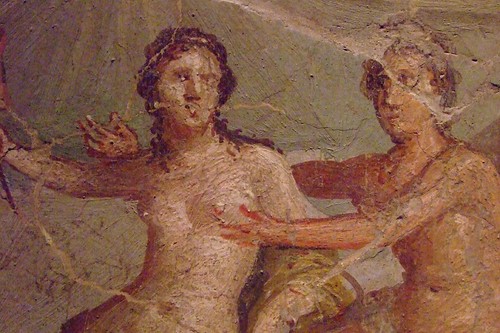
[Image: Ertoic fresco excavated from Pompeii displayed in the 'Secret Room' of the Naples Archaeological Museum.  Photo by Mary Harrsch]

If you've ever visited the "Secret Room" inside the Museo Archaeologico di Napoli in Naples, you will have no doubt that the ancients definitely enjoyed their carnal pleasure. But did they go so far as to make the deflowering of virgins part of their worship of their respective goddesses of love?

The Greek geographer Strabo thought so claiming that Persians living along the shores of the Black Sea dedicated their "virgin daughters," hardly 12 years old, to cult prostitution.

But, a small group of female gender researchers led by American scholar Julia Assante claim it's all the product of overactive male imaginations. (After all, I saw a program this week on Good Morning America about the differences in the male and female brain where a doctor was discussing how the male brain is "marinated" in testoterone!)

More moderate scholars, however, think disavowing all sacred sexual practices goes a bit too far and have expressed their opinions that there were once:

* Temples that operated brothels on the side;

* Temples in which girls held the highest offices of the priesthood, even before their first menstruation;

* Professional harlots who donated their own money to cult sites, such as a site devoted to the goddess "Aphrodite Porne."

But with all those huge buildings dedicated to Ishtar, the goddess of love, there was not a single instance of ritual depravity?

Gernot Wilhelm, an Orientalist at Julis Maximilian University in Würzburg, Germany discovered a 3,300 year-old legal document that recounts how a man delivered his own daughter to the Temple of Ishtar to serve as a Harimtu.

According to the document, the man wanted a loan from the priests and was offering his daughter as collateral.

But what exactly did the pawned daughter do for her new employers? Wilhelm speculates that the young girl worked as a prostitute, "but outside the temple."

As evidence, the professor cites the "Book of Baruch" in the Old Testament. It describes prostitutes standing "along the paths" between the dusty houses of Babylon. They too were somehow associated with a sacred organization. - "Did Prostitution Really Exist in the Temples of Antiquity? by Matthius Schulz
Assante and her colleagues dispute this interpretation, however.  She says a Harimtu was not a prostitute but just a single woman serving as a cult official.

Her reinterpretation of the word Harimtu doesn't make semantic sense, says economic historian Morris Silver. He insists that the Harimtu were clearly "professional prostitutes with cultic connections," who offered a "sexual service" on behalf of the temple. Priests acted as pimps and collected some of the profits. - "Did Prostitution Really Exist in the Temples of Antiquity? by Matthius Schulz
Other scholars point to the accounts of prostitution surrounding the Temple of Aphrodite in Corinth.  Strabo reports the temple owned a stable of over 1,000 prostitutes (I thought he was supposed to be interested in geography?)  Tanja Scheer, a professor of ancient history at the University of Oldenburg in northern Germany blames it all on an ode to Pindar.

"Pindar writes that a wealthy Olympic champion dedicated the temple to a "hundred-limbed" throng of prostitutes in 464 B.C.," Scheer points out,  "It is unlikely that the prostitutes lounged directly at the altar. Instead the wealthy athlete probably offered the temple financial assistance in the form of female slaves."

Scheer bases her theory on the fact that the Athenian statesman Solon taxed prostitutes working in government houses of pleasure in Athens around 590 B.C.. The revenues were subsequently used to build a temple for worshipers of the goddess of love.  Then somehow the construction of the temple became entangled with the source of the money used to build it in subsequent oral histories .
 
Besides, if you take Pindar literally, a "hundred-limbed" throng of prostitutes would have been only a mere 25 if you count all four limbs or 50 if you count just their arms - that seems a far cry from 1,000.

Strabo's sexual fantasies didn't end there, though, either.  He went on to claim that loose women also inhabited the Temple of Amun in Thebes (Egypt) where they served as godly consorts.

Strabo writes, "a maiden of greatest beauty and most illustrious family prostitutes herself, and cohabits with whatever men she wishes until the natural cleansing of her body takes place" (menstruation). 


 Researchers do admit that a recently translated papyrus fragment does refer to young girls in service to the god.

According to the text, girls are permitted to work in the temple until their first menstruation. After that, however, "they are cast out from their duties." - "Did Prostitution Really Exist in the Temples of Antiquity? by Matthius Schulz
So, as they say on that tabloid TV show, "What side are you on?"

 The Myth of Sacred Prostitution in Antiquity   Prostitutes and Courtesans in the Ancient World (Wisconsin Studies in Classics)   Trying Neaira: The True Story of a Courtesan's Scandalous Life in Ancient Greece   Courtesans & Fishcakes: The Consuming Passions of Classical Athens   Courtesans at Table: Gender and Greek Literary Culture in Athenaeus  
If you enjoyed this post, never miss out on future posts by following me by email!


Friday, March 12, 2010

Wallace-Hadrill to present Herculaneum: Living with Catastrophe in Lexington, VA

I see that Dr. Andrew Wallace-Hadrill will present Herculaneum: Living with Catastrophe at Washington and Lee University, Lexington, Virginia on Tuesday, March 23, at 7 p.m. in the Stackhouse Theater.  Oh how I wish I could attend that lecture.  I love living on the west coast but up here in the Pacific Northwest we seldom get the opportunity to hear such world class presentations from classical scholars like Dr. Wallace-Hadrill.

[Image of  Dr. Wallace-Hadrill courtesy of  The Alleghany Journal]

Roman Mosaic found in the ruins of Herculaneum 1st century CE (1)I always enjoy his insight that he has shared in numerous History Channel programs.  Even after all of the years he has spent studying ancient Rome, he still talks about it with such marvelous enthusiasm.  I had hoped to catch a glimpse of him when I visited Herculaneum in October 2007, but no such luck. I did watch some of his researchers working on this beautiful mosaic in a bath complex:

[Image: 1st century CE Roman mosaic found in the ruins of Herculaneum.  Photographed by Mary Harrsch]


Herculaneum is a rather small excavation compared to Pompeii so I was able to explore it in about half a day.  There is much more of the site as yet unexplored but it has been covered by the modern city of Naples so it is doubtful any more of the ancient complex will be unearthed (except perhaps, sadly, by tunneling looters). Much of the artwork originally found in Herculaneum has been removed and placed in the Museo Archaeologico di Napoli but there are still a few pieces in situ.

The day I was there, the Villa di Papiri was closed because of ongoing excavations there.  I would have loved to have seen it, too, so I could compare the layout to the Getty Villa in Malibu that is based upon it.

Herculaneum: Italy's Buried Treasure   Secrets of the Dead - Herculaneum Uncovered   The Library of the Villa dei Papiri at Herculaneum   Vesuvius, A.D. 79: The Destruction of Pompeii and Herculaneum   Antiquity Recovered: The Legacy of Pompeii and Herculaneum (J. Paul Getty Museum)   Houses and Society in Pompeii and Herculaneum   An Introduction to Wall Inscriptions from Pompeii and Herculaneum (From Pompeii and Herculaneum)
If you enjoyed this post, never miss out on future posts by following me by email!


Thursday, March 11, 2010

Ancient Vine Delights Visitors with Beautiful Recreations of Ancient Life

Today I received a news alert from Heritage Key about the impending illumination of Hadrian's Wall event and it included a marvelous video of a 3D recreation of Hadrian's Wall and Newcastle Fort by a system's analyst known as Decimus who manages a website called Ancient Vine.  The graphics in the video were absolutely stunning.


I actually thought Decimus had merged 3D computer graphics with live action because the soldiers in the video looked so lifelike.  When I visited his site I saw that they were creations of his talent as well:


Decimus has also created a virtual Roman domus as part of the exhibit "A Day in Pompeii" at Museum Victoria in Melbourne, Australia.

Above is Decimus' recreation of a Roman tablinum.  The museum created a wonderful video of a virtual visit to the domus complete with rain water falling in the atrium, music and background sound effects.

He is now working on a reconstruction of the ancient city of Alexandria.


He has already finished several iterations of the Pharos lighthouse and is presently working on a recreation of the famous library.

Decimus is also working on a game set in the fictional Roman town of Opacia that was built on the ruins of Oplontis.  It will be an adventure/role playing game and I'm sure the visuals alone would make it well worth the price of the final product!

He has a marvelous image gallery and even offers his graphics for free use with attribution.  His site also features a discussion forum with interesting discussions about both Roman History and 3D graphics tools.  So, please check out Ancient Vine and continue to encourage such an artistic enthusiast!

Roman Art in the Private Sphere: New Perspectives on the Architecture and Decor of the Domus, Villa, and Insula   Pompeii and the Roman Villa: Art and Culture Around the Bay of Naples   Pompeii and the Roman Villa   In Stabiano: Exploring Ancient Roman Villas
If you enjoyed this post, never miss out on future posts by following me by email!


Sunday, March 7, 2010

HBO’s Rome Gets a Big Screen Script

It looks like Bruno Heller's plans to resurrect Vorenus and Pullo in a big screen treatment of HBO's Rome is moving forward.  According to this article, a script has been written and financing has been secured for the project.  I was at least relieved to see that the story would resume just four years after the original miniseries concluded.  I had read at one point that there were rumors Heller was going to take the boys to Judea for a rendezvous with a certain messiah which, of course, didn't make any sense at all since Vorenus and Pullo would have been so old they couldn't have lifted a gladius.

According to this release, we will find them fighting the barbarians in Germania - much better!  Kevin McKidd must be juggling the project with his appearances on "Grey's Anatomy".  McKidd appears to have been much more successful than Ray Stevenson at using the popularity he gained from "Rome" to leverage his career.  His own series on NBC, "Journeyman", only lasted a year but was a good effort.  I also saw him in "Made of Honor" with Patrick Dempsey who may have helped him land a spot on "Grey's Anatomy".  Stevenson has made a few films but none that garnered much notice.  He was such a natural in his role as Pullo.  It will be good to see him back in a starring role again with a good script to demonstrate his talent as well.

 
HBO’s Rome Gets a Big Screen Script
If you enjoyed this post, never miss out on future posts by following me by email!


Friday, February 26, 2010

Routine Child Sacrifice Not Practiced by Ancient Carthaginians After All

Although Hannibal was used as a "boogey man" to scare misbehaving Roman children, Carthaginians did not, contrary to popular myth, actually wantonly sacrifice their children according to a new report by researchers from the University of Pittsburg.

The scientists examined the remains of children found in Tophets, structures on the margins of Punic cemetaries where urns containing the remains of young children and animals were placed.  The contents of 348 urns were inspected for developmental markers that would reveal the children's age at death.

[Image: Medea Killing Her Sons by Delacroix, 1862.  Courtesy of Wikimedia Commons]

"Schwartz [Jeffrey H. Schwartz, a professor of anthropology and history and philosophy of science in Pitt's School of Arts and Sciences and president of the World Academy of Art and Science] and Houghton [Frank Houghton of the Veterans Research Foundation of Pittsburgh] recorded skull, hip, long bone, and tooth measurements that indicated most of the children died in their first year with a sizeable number aged only two to five months, and that at least 20 percent of the sample was prenatal."

"Schwartz and Houghton then selected teeth from 50 individuals they concluded had died before or shortly after birth and sent them to Macchiarelli and Bondioli, who examined the samples for a neonatal line. This opaque band forms in human teeth between the interruption of enamel production at birth and its resumption within two weeks of life. Identification of this line is commonly used to determine an infant's age at death. Macchiarelli and Bondioli found a neonatal line in the teeth of 24 individuals, meaning that the remaining 26 individuals died prenatally or within two weeks of birth, the researchers reported."

"The team's report also disputes the contention that Carthaginians specifically sacrificed first-born males. Schwartz and Houghton determined sex by measuring the sciatic notch&'a crevice at the rear of the pelvis that's wider in females&'of 70 hipbones. They discovered that 38 pelvises came from females and 26 from males. Two others were likely female, one likely male, and three undetermined." - More: Spero News

Carthage: A Journey Back in Time (Lost Treasures of the Ancient World)    History - Engineering An Empire: Carthage   The Punic Wars: Rome, Carthage, and the Struggle for the Mediterranean   Dying for the Gods: Human Sacrifice in Iron Age & Roman Europe   Some Inquiries Concerning Human Sacrifices Among the Romans
If you enjoyed this post, never miss out on future posts by following me by email!