Monday, September 28, 2009

Possible Victims of Trojan War unearthed in Turkey


A team from the University of Tubingen, led by Ernst Pernicka, have uncovered a pair of skeletons in the ancient city of Troy near ceramic fragments dated to the period of the Trojan War. It is discoveries like this that remind us how important literature like Homer's Iliad is to understanding our ancient past. It will really blow me away if they find a skeleton of an infant with its head crushed. We could then be looking at the only corporeal remnant of the famous Hector, trainer of horses!

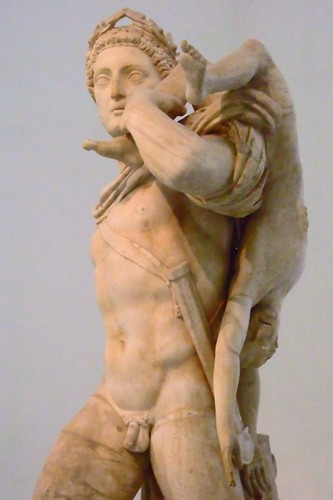
[Image - Warrior with captured child, Roman copy of 3rd century BCE Greek original. Photographed at the Museo Archaeologico di Napoli, Naples, Italy by Mary Harrsch.]

This discovery, though, also raises the question about disposal of "enemy" dead after a catastrophic sack. Both the Greeks and the Trojans at the time practiced cremation. If skeletons are found that could have been retrieved for burial, it makes a person wonder if the Greeks not only violated religious taboos by slaughtering people who had fled to the temples for sanctuary, but did not grant the defeated and enslaved survivors the courtesy of properly burying their dead either. Perhaps the violent deaths later visited upon the Mycenaean victors were just desserts after all.

"Pernicka said pottery found near the bodies, which had their lower parts missing, was confirmed to be from 1,200 BC, but added the couple could have been buried 400 years later in a burial site in what archaeologists call Troy VI or Troy VII, different layers of ruins at Troy. professor of archaeometry who is leading excavations on the site in northwestern Turkey, said the bodies were found near a defense line within the city built in the late Bronze age.

The discovery could add to evidence that Troy's lower area was bigger in the late Bronze Age than previously thought, changing scholars' perceptions about the city of the "Iliad."

"If the remains are confirmed to be from 1,200 B.C. it would coincide with the Trojan war period. These people were buried near a mote. We are conducting radiocarbon testing, but the finding is electrifying," Pernicka told Reuters in a telephone interview.

Pernicka said pottery found near the bodies, which had their lower parts missing, was confirmed to be from 1,200 BC, but added the couple could have been buried 400 years later in a burial site in what archaeologists call Troy VI or Troy VII, different layers of ruins at Troy.

If you enjoyed this post, never miss out on future posts by following me by email!


Friday, September 25, 2009

Pompeii exhibit nears its end in Los Angeles


The fantastic exhibit "Pompeii and the Roman Villa: Art and Culture Along the Bay of Naples" at the Los Angeles County Museum of Art will be closing soon (October 4, 2009). If you haven't seen it yet, I would heartily recommend it.

I had the opportunity to see this exhibit last month while I was in the area attending a donor fund raising event for the Gallery of Historical Figures. I was particularly fascinated by the emphasis on archaism in Roman art, so much so that I wrote an extensive article about it for Heritage Key. Heritage Key is a new website that came online in June 2009 that focuses on the ancient and prehistoric world before 600 CE. The executive director, Jon Himoff, asked if I would be interested in writing articles for them and I agreed. If you haven't explored their website yet, I would encourage you to do so as they not only have some fascinating articles to read but have a virtual recreation of King Tut's tomb that you explore using an interface very similar to the one used in Second Life.

[Image: Bronze Replica of a Wild Boar at the House of the Chitharist in Pompeii. Photograph by Mary Harrsch]

At the Pompeii exhibit I was also finally able to see the original wild boar surrounded by hunting hounds sculpture from the House of the Citharist. In Pompeii there is a marvelous
replica of the work in situ but there is nothing like seeing the real thing. I'm afraid I was teased by my friends for traveling all the way to Pompeii (about a 20 hour flight with plane changes for me)
to see a replica then just taking a short hop (2 hours from here) down to L.A. to see the original!

I also saw a fresco of the Three Graces from an insula in Pompeii. It looks very much like a mosaic of the Three Graces from the House of Apollo in Pompeii that I photographed at the Museo Archaeologico di Napoli two years ago.

[Image - Mosaic of The Three Graces from the House of Apollo in Pompeii. Photographed at the Museo Archaeologico di Napoli in Naples, Italy by Mary Harrsch.]

I was also excited to finally get to see the beautiful ceremonial gladiator helmet that I had heard about but was unable to see at the museum in Naples because it was on tour at the time.

The ornate Thracian-style helmet was beautifully embossed with scenes from the Fall of Troy. The curators felt that the helmet was probably ceremonial because of the detail on it. It was probably worn during the pompa or parade of the gladiators that preceded the combat portion of the games.
If you enjoyed this post, never miss out on future posts by following me by email!


Monday, August 31, 2009

"Legacy of Carthage" exhibit tours Japan


I saw a note about this wonderful exhibit that is presently opening in Kanazawa, Japan. I wonder if this lovely relief depicts the legendary queen Dido?

The “Legacy of Carthage” will travel throughout 10 Japanese cities to showcase Tunisia’s rich Carthaginian and Roman legacy. The exhibition includes rare, authentic pieces dating back to the Punic and Phoenician eras. It also offers an opportunity for Japanese visitors to admire some splendid 2 nd and 3 rd century frescoes and mosaics discovered in Carthage, El Jem,Utica, Sbeitla, Sousse, as well as in other Tunisian cities. - Tunisia Online News

The exhibit is slated to travel from Kanazawa to Tokyo, then Okyama, Kyoto, Hamamatsu, Miyazaki and Nagoya. I wish it would make an appearance here in the U.S. I saw some truly spectacular mosaics from Tunisia at an exhibit at the Getty Villa a year ago and I would love to see more remnants of Roman North Africa as well as pre-Roman artifacts.

As much as I love to study Roman civilization, I find Carthage, a colony of Phoenicia, fascinating as well. Its too bad that Rome felt compelled to destroy Carthage instead of absorbing it like it did so many other cultures. Here's the first of a series of videos about the fate of Carthage, entitled "The Roman Holocaust":


Of course, one of my favorite videos about Carthage is "Engineering an Empire".

If you enjoyed this post, never miss out on future posts by following me by email!


Thursday, July 23, 2009

Caesar's Fables and the Price of Fame


I was working on my "virtual" Julius Caesar today, a natural language conversational agent depicting a resurrected Julius Caesar, when I happened upon this fascinating excerpt from Maria Wyke's book, "Caesar: A Life in Western Culture" about all of the fables that have grown up around the man and the myth that was Julius Caesar. I had been specifically searching for references to his unique horse "Toes".

Wyke observes:

Every conqueror needs a distinguished horse which only he can ride. A number of classical sources note that Julius Caesar possessed such a horse, born on his own lands, whose front hooves resembled feet since they were divided in such a way that they looked like toes. This unusual condition was interpreted by a soothsayer as an omen that the master of such a horse would one day rule the world. Naturally, the horse would endure no other rider save Caesar. This observation in Caesar’s ancient biography seems to recall the characteristics of Bucephalus, the wild horse tamed by Alexander, which provided that hero too with an oracle predicting world empire. In medieval romance, Alexander’s horse becomes a horned creature so wild that it eats men. In a later medieval epic on Julius Caesar, in addition to unmistakable feet, his horse gains a fabulous horn on its head with which it can topple other riders and their mounts. A number of depictions survive in which this mythic horse (rather than its owner) is in sharp focus. A colourful earthenware dish of the early sixteenth century, which captures a moment in the triumph of Julius Caesar, appears to jettison the medieval horn in favour of a more rational spike attached to a harness, but all four of the horse’s human feet remain clearly visible as it is ridden on parade by a youth, who carries a globetipped branch to signify that their master is ruler of the whole world . - Caesar: A Life in Western Culture

I found her discussion of Caesar as one of the medieval "Nine Worthies" quite interesting as well:

The mature Caesar was also included in the medieval canon of the Western world’s greatest military heroes. This collection of champions, or Nine Worthies (‘neuf preux’), was first identified, categorized, and made popular in the early fourteenth century in a poem composed by a French jongleur or itinerant ministrel. Joining a neatly composed arrangement of three Christians, three Hebrews and two other pagans (Hector and Alexander the Great), Julius Caesar along with the rest was made to embody chivalric goodness, wisdom, prowess and valour. Perfect warriors, the Nine Worthies conferred glory on their nations and provided patterns of both military virtue and moral conduct for imitation. They frequently appeared on frescoes, tapestries, enamelled cups and playing cards owned by medieval princes and noblemen. In a similar way to a collection of saints, their role was to exhort a supposedly degenerate present to live up to medieval ideals projected back into the past. In this line-up, Julius Caesar was conventionally distinguished by his imperial crown and the crest of a two-headed eagle emblazoned on his medieval armour. In a fourteenth-century tapestry of the Nine Worthies commissioned by the Duke of Berry (and now surviving only in parts), a majestic and heavily bearded Caesar sits enthroned within a fantastic Gothic niche. He grasps a broad, unsheathed sword and is surrounded by his courtiers (mainly musicians, but also a soldier and, directly above him, his lady). His heraldic symbol of the double-headed imperial eagle is woven in sable on gold." Caesar: A Life in Western Culture

The idea of a heavily-bearded Caesar seemed pretty far-fetched since Caesar was so meticulous about his appearance he frequently had his body plucked to remove any unsightly hair (except on the top of his head) and all ancient sculptures of him show him clean shaven like most military men of the late Republican era.

[Image: Imperial Statue from the Antonine Period with modern head of Julius Caesar, Museo Archaeologico di Napoli. Photo by Mary Harrsch]

Wyke also said medieval chroniclers further elaborated on the evil portents preceding Caesar's assassination. In addition to the ancient references to horses Caesar had dedicated to the gods that would no longer graze but wept abundantly; a bull Caesar was sacrificing turning out to have no heart and a ‘king’ bird torn to pieces by other birds in Rome’s senate-hall, a 15th century poem related:

"... on that dark night, at the sixth hour, when the betrayal was arranged, terrible voices were heard clamouring in the sky, the earth quaked as if it were releasing a great sigh, fires with bloody tails circled through the air in battle, a lamb cried out ‘Slaughter! Slaughter!’, oxen pointed out to their ploughmen the pointlessness of carrying on …"

These strange manifestations of fame that Caesar openly sought seem to point to the fulfillment of an eerie prophecy by Cicero during his own on-again, off-again relationship with Caesar.

"Posterity will be staggered to hear and read of the military commands you have held and the provinces you have ruled … battles without number, fabulous victories, monuments and shows and Triumphs. And yet unless you now restore this city of ours to stability by measures of reorganization and lawgiving, your renown, however far and wide it may roam, will never be able to find a settled dwelling-place or firm abode. For among men still unborn, as among ourselves, there will rage sharp disagreements. Some will glorify your exploits to the skies. But others, I suggest, may find something lacking, and something vital at that. (Cicero, pro Marcello 28รป9. Trans. M. Grant, 1969)"

[Image: Marcus Tullius Cicero. 1st century BCE. Capitoline Museum, Rome, Italy. Photograph by Mary Harrsch]

Yet, the two-edged nature of such fame, however, has served men's purposes through the centuries.

"Caesar has been deployed to legitimate or undermine the authority of kings, to justify or denounce the coups of generals, to launch or obstruct revolutions, to demonstrate incisive literary style and perfect grammar, to teach military strategy and tactics or the workings of fortune and destiny, to display luxury, to play out sexual excess, to stimulate expenditure and consumption. Moreover, the history of Caesar’s reception is not only a matter of re-presenting him in ways that speak to the present (in paintings, plays, novels, operas, films and computer games, as well as in political speeches and historical treatises); it is also often a matter of adopting aspects of his life in someone else’s, or replicating his murder for political reasons—a matter of becoming or removing a new Caesar. - Caesar: A Life in Western Culture

Like Achilles who accepted death to obtain enduring fame, I think Caesar would have found it a worthy trade off.
If you enjoyed this post, never miss out on future posts by following me by email!


Tuesday, July 21, 2009

Fabula Atellana Masks from Pompeii Rediscovered

This mask of Atellan character, Buccus [left], seems to have a more human expression, despite the prescribed comic grimace, than the more stilted and formal masks I have seen elsewhere like the theater at Ostia Antica. Of course it could have been distorted from volcanic heat following the eruption of Vesuvius.

The Discovery article describing a collection of masks recently "rediscovered" from Pompeii pointed out that some of the masks had closed mouths indicating they were used as models for the mask craftsman. However, the masks could have been worn by dancers in a pantomine, who wore masks with closed mouths because they did not speak but performed using only expressive gestures.

"...the most popular genres were unquestionably mime and pantomime, which sought to please the audience. Here even nudatio mimarum (a sort of striptease) was sometimes staged or, more surprising yet, the reenaction of real executions and torture. Mime was based on action and performed without masks. It was the only type of performance in which women played the female roles."

The number of days devoted annually to [theatrical] games gradually increased over time. At the end of the third century BC there were probably twelve at the most and, yet, at the beginning of the Empire, there were already 56 consecrated to theatre performances, reaching 100 by the mid-fourth century AD - The Roman Theater: Staging the Performance
A set of 15 mysterious life-size masks, reminiscent of ancient Roman drama, have been rediscovered in Pompeii after being forgotten for more than two centuries, according to Italian archaeologists who have shown them for the first time at an exhibition in Naples, Italy.

Made of plaster, the rather heavy masks were unearthed in 1749 in Pompeii during the excavations promoted by King Charles of Bourbon. They were deposited, along with many other artifacts, in the Royal Palace of Portici, a town on the Bay of Naples.

"Two masks show letters in the space usually reserved to the mouth. While the meaning of one is incomprehensible, on the other we can clearly read the word 'Buco,'" Borriello said. The word refers to Buccus, a stock character from the earliest form of Italian farce, known as fabula Atellana.

Deriving its name from the town of Atella in the southern Campania region, the fabula Atellana was a form of entertainment widely popular from the second century B.C. to the fourth century A.D. Basically a form of improvised farce, it used masked actors, stock characters and conventional plots. - More: Discovery News

Atellan farces also relied on the physical comedy of slapstick and burlesque.

By the early Imperial period, Atellan farces were no longer improvisational, but scripted performances.

Livy describes the Atellan Farces and the names for the actors (histriones) in section 7.2. of his History of Rome, where he says the Romans first performed them to try to fight a pestilence (in 363 B.C., according to Richard C. Beacham in The Roman Theatre and Its Audience). - About.com


If you enjoyed this post, never miss out on future posts by following me by email!